
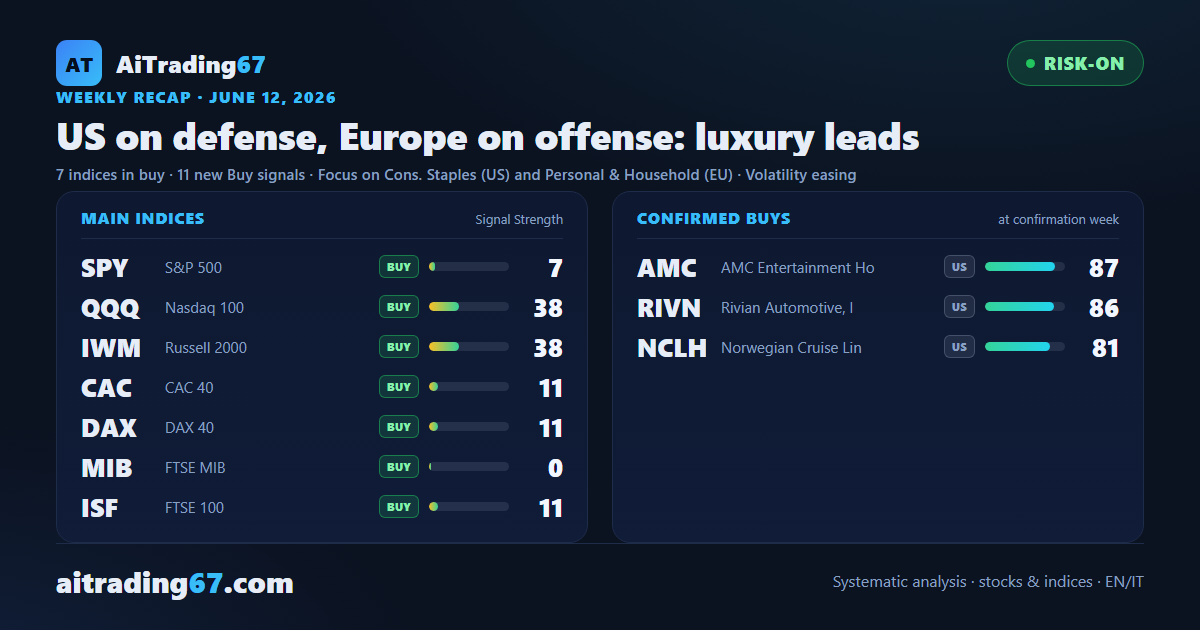
Weekly recap · June 12, 2026
US on defense, Europe on offense: luxury leads
7 indices in buy · 11 new Buy signals · Focus on Cons. Staples (US) and Personal & Household (EU) · Volatility easing
01
The week in view
All 7 of our benchmark indices remain in buy mode, but the picture is mature rather than euphoric: internal momentum has cooled almost everywhere and several markets are working just below their highs. The broad backdrop stays supportive — volatility has receded and market breadth has recovered — yet the week has a defensive flavour: within equities money has shifted toward the steadier sectors, while gold, oil and shipping rates sit in critical territory. This is rotation, not risk-off.
02
Macro regime
market contextRisk-On
Overall supportive macro: volatility has settled and bond markets are calm, the dollar is steady, but commodities and energy are pulling back sharply.
VIX
Neutral
MOVE
Favorable
DXY
Neutral
Breadth
Neutral
03
Main indices
7 Broad ETFsUS markets remain the strongest, with Russell small caps now brushing their highs and the Nasdaq still full of structure; the S&P holds but with the weakest push of the group. Europe looks more tired: Paris, Frankfurt, Milan and London keep their buy signal but with internal strength worn thin — trades to manage, not to chase.
State Street SPDR S&P 500 ETF (SPY)Buy · open›
The S&P 500 has been in buy mode for 9 weeks and the weekly signal still holds, but it is the most mature read of the group: Signal Strength has fallen to 7 out of 100, a sign that internal thrust is nearly spent. Price is working a hair below record highs and two of our model's three targets have already been reached. It holds, but this is no time to chase: a trade to manage with discipline.
Signal Strength7 / 100
Invesco QQQ Trust Series I (QQQ)Buy · open›
The Nasdaq 100 has been buying for 8 weeks with a medium Signal Strength of 38 out of 100: livelier than the S&P but cooling. The index keeps full structure and sits less than 4% below its highs, yet momentum is fading and the model's first target is already behind it. Tech leadership has paused: the signal holds, the thrust needs watching.
Signal Strength38 / 100
iShares Russell 2000 ETF (IWM)Buy · open›
The Russell 2000 has been buying for 9 weeks and is the closest to its highs of all, less than 1% away. Signal Strength is medium at 38 out of 100, and two of the three targets have already been hit: the weekly structure is full, the moving averages aligned. Small caps remain the most offensive face of the US market, but with two thirds of the model's path already covered, management matters more than enthusiasm.
Signal Strength38 / 100
Multi Units France Sicav (CAC)Buy · open›
The CAC 40 has been buying for 9 weeks but is among the weakest internally: Signal Strength has dropped to 11 out of 100 and our model advises against fresh entries. Price is just over 1% below the highs and none of the targets has yet been touched. It is the portrait of a trade under observation: to accompany with caution, not to add to.
Signal Strength11 / 100
Amundi DAX II UCITS ETF Acc (DAX)Buy · open›
The DAX has been buying for 8 weeks, with a weak Signal Strength of 11 out of 100 and a confirmation week that closed lower. Structure holds and price stays about 4% below the highs, but the picture is one of a mature advance: our model suggests managing what exists, not adding. Industrials, financials and technology account for much of the index.
Signal Strength11 / 100
Amundi FTSE MIB UCITS ETF (MIB)Buy · open›
The FTSE MIB has been buying for 9 weeks, but it is the index with the most exhausted momentum: Signal Strength is at 0 out of 100 and all three of the model's targets have already been reached. Structure is still full, yet the thrust that supported it appears spent. A trade that has run to the end of its natural course: discipline points to an orderly exit, not a fresh push.
Signal Strength0 / 100
iShares Core FTSE 100 UCITS ETF (ISF)Buy · open›
The FTSE 100 has been buying for 9 weeks and holds its weekly structure, but signs of fatigue are piling up: Signal Strength is low at 11 out of 100, the long-term filter is unfavourable and the daily picture is cooler, with price inside the equilibrium cloud. It is a running trade to accompany with caution: it holds, but asks for attention rather than additions.
Signal Strength11 / 100
04
Sector rotation
US · EuropeIn the US the defensive sectors lead — consumer staples, real estate and financials at the front — while technology, the long-standing leader, takes a breather and sits at the bottom of the weekly table alongside energy. In Europe the picture is more cyclical: personal and luxury goods pull ahead, followed by banks, with oil and gas trailing. Two geographies, two speeds: caution across the Atlantic, broader participation on the Continent.
US sectors
XLP›
State Street Consumer Staples
rising · +3.91%
XLRE›
State Street Real Estate Selec
rising · +2.32%
XLF›
State Street Financial Select
rising · +1.84%
XLB›
State Street Materials Select
rising · +1.50%
XLU›
State Street Utilities Select
rising · +1.11%
XLI›
State Street Industrial Select
rising · +0.32%
XLC›
State Street Communication Ser
falling · -1.01%
XLE›
State Street Energy Select Sec
falling · -1.90%
XLK›
State Street Technology Select
falling · -2.16%
European sectors
EXH7›
EXH7
rising · +6.06%
EXV1›
iShares STOXX Europe 600 Banks
rising · +2.55%
EXV4›
iShares STOXX Europe 600 Healt
rising · +1.82%
EXV3›
iShares STOXX Europe 600 Techn
rising · +1.66%
EXH9›
iShares STOXX Europe 600 Utili
rising · +1.59%
EXV2›
iShares STOXX Europe 600 Telec
rising · +0.93%
EXH4›
iShares STOXX Europe 600 Indus
falling · -1.16%
EXHG›
EXHG
falling · -1.19%
EXH1›
iShares STOXX Europe 600 Oil &
falling · -1.24%
05
Confirmed Buy signals
at the confirmation weekFive US stocks have passed the first test: the buy signal that started the week before closed its confirmation week in positive territory. For our method that detail matters, because a signal that holds its first check rests on firmer ground than one just born. The group is mixed, and that is the interesting part: two high-volatility, high-thrust names like AMC and Rivian, cruise operator Norwegian Cruise Line, but also two steadier, quieter profiles such as Danaher in healthcare and Wells Fargo among financials. From Europe, this week, no confirmations: the Continent's new signals are mostly just out of the gate and still have their first test ahead. It is worth reading the individual cards to see which of these confirmations rest on genuinely orderly structure and which live mainly on momentum — the choice, as always, stays with the reader.
1
AMC
AMC Entertainment Holdings, Inc. Class A
Strength 87
›
2
RIVN
Rivian Automotive, Inc. Class A
Strength 86
›
3
NCLH
Norwegian Cruise Line Holdings Ltd.
Strength 81
›
4
DHR
Danaher Corporation
Strength 59
›
5
WFC
Wells Fargo & Co
Strength 55
›
None this week
06
Ranker rankings
Top by Signal StrengthIn a defensively-minded week, the five new US signals draw mostly from the sectors leading the rotation — healthcare and financials. The exceptions top the table: cruise pair Carnival and Royal Caribbean, neck and neck on the group's highest Strength — a wide move, one to handle with discipline. Just behind, two defensive heavyweights, Amgen in biotech and Johnson & Johnson in pharma, where interest rewards solidity over momentum; Bank of America rounds things off, bringing banks into the new entries. On some of these names our model already counsels caution, on others the picture is more convincing. It is a block that mirrors the week well: money rotating toward what protects, with a livelier bet or two at the edges. Worth opening each one in the individual posts.
Among the 145 open US longs, the top of the table tells of trades that have worked — and worked well. Fortinet leads at week six with its stop already at breakeven and the model's targets cleared; Advanced Micro Devices and Roku have been running for nine weeks, margins wide and risk now zeroed out. The standout is Sandisk: a signal from months back, its remaining capital left to run far beyond entry and the stop trailing the rally into automatic protection. These are mature positions, not new openings: the point here isn't to enter but to see how far each trade has come and how the method accompanies a winner — when it banks the targets, when it lets the rest run. The individual posts lay out the week-by-week roadmap.
On the sell side, the week lines up familiar names our model sees cooling — many from the sectors that took a breather this week. The communication-services ETF leads, followed by two Chinese names, Li Auto and Baidu, where the weekly weakness signal is the sharpest; alongside them a heavyweight like Netflix and a long-standing defensive such as Abbott. Read this block as caution, not action: these aren't invitations to short, but names where the picture suggests not chasing rallies and waiting for a fresh buy signal. For those following them, the value lies in spotting what cracked in the weekly structure: the individual posts show where, and which levels to watch before looking again with interest.
Europe is the real engine of the week, and the new signals show it: luxury out front. Kering and LVMH open the table, followed by Ferrari — the sector is moving again and deserves a look after difficult months. Right behind, two Milan stars, Unipol in insurance and BPER among banks, confirm the Italian financial front stays lively. The block captures Europe's dual soul these days: luxury trying to restart, and the solidity of domestic banks and insurers. Five different stories, each with its own Strength and activation level: the individual posts go into detail and help you build your own read before deciding.
Among open European positions, the top is balanced between industry and finance. Infineon, the German chip giant, leads the group, flanked by two healthy Italian banks, Banco BPM and Monte dei Paschi, and by Brunello Cucinelli's elegance in accessible luxury. These are trades that continue, some with good margins banked and the stop already secured. As in the US, the point of this block isn't to find an entry but to watch how earlier signals are maturing: which keep their drive, which start to tire. For those eyeing these names, the individual posts tell which week each trade has reached and what to expect from the next management window.
The European picture closes with the sell side, a handful of quality names in a cooling phase. Campari and Legrand, long-term portfolio stocks, show a weekly weakness signal; alongside them BMW in German autos, Infrastrutture Wireless Italiane, and Dassault Systèmes in French software. This isn't a call to sell, but a map of where the weekly structure has weakened: names where the model suggests not chasing and waiting for the picture to settle. And it is often the quality names, once cooled, that later offer the best entry points. The individual posts explain what changed and which thresholds to watch for when interest might return.
Methodology note — Nothing written here constitutes financial advice, a solicitation to buy or sell financial instruments, or any kind of recommendation. Past performance is not indicative of future results. Trading involves significant risk of loss; the user acts under their own responsibility. Signal Strength is an internal analytical framework used only to rank relative technical quality within the basket. © Fabio Gentili.