
The week banks and energy took the wheel, on both sides of the Atlantic
Macro context
The underlying regime stays constructive, but with a few cracks worth reading. Equity volatility has turned higher and now sits in cautionary territory: not an alarm, but a sign that investors demand a higher premium to stay exposed. On the bond side tension remains contained and tail-risk perception is orderly, which tells us the nervousness is selective, concentrated in equities rather than spread across the whole system.
Market breadth, meaning how many companies truly take part in the move, has softened somewhat: the push comes from fewer names, and this ties directly to what we will see across sectors. The dollar shows gradual improvement, consistent with a more measured appetite for risk. Commodities tell the most interesting part of the story: gold has come under pressure, in critical territory, and oil remains weak. When the ultimate safe haven retreats while equities rotate toward value, the message is repositioning, not fear.
The overall read is of a symmetric rotation with different accents. In the US leadership changed hands sharply and somewhat abruptly; in Europe the move is broader and more orderly. Two markets heading the same way, but with opposite styles.
US sectors
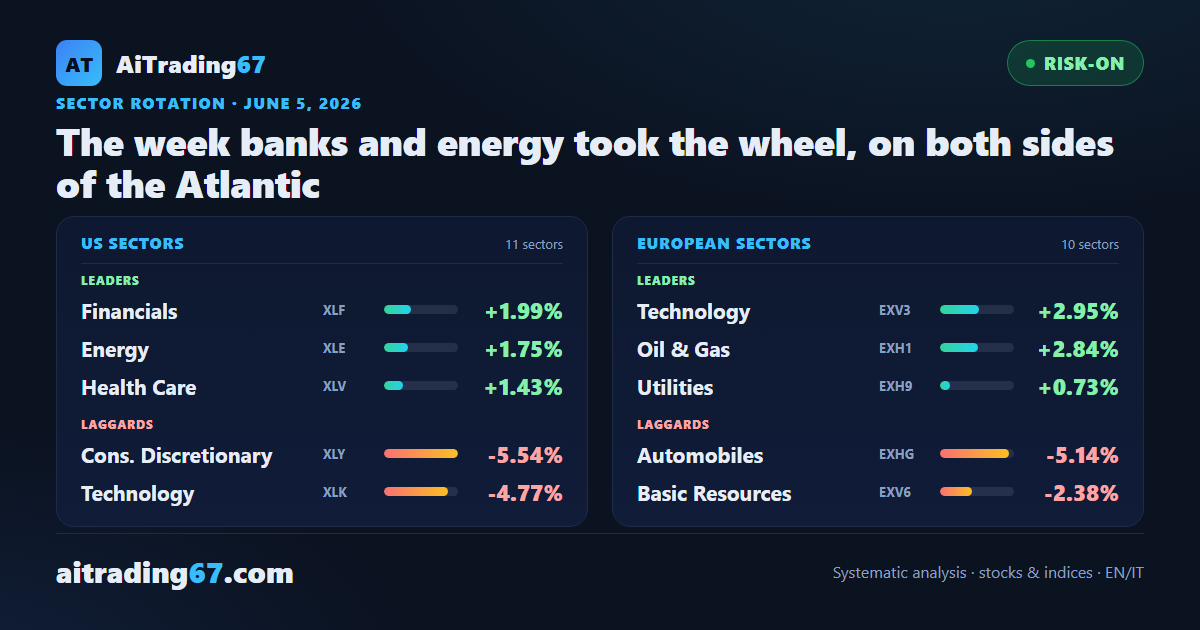
The standout is technology's about-face. The US tech sector sheds nearly 5% (-4.77%) on the week and, despite still-stretched momentum (RSI 70.1) and marked directionality (ADX 29.4), its strength histogram is deflating: the candle turned lower from a very high level, and that is the signal the market is lightening up where it had run the most. Alongside, discretionary consumption brings up the rear at -5.54%, and communications fall 3.67%, both now slipped below their trend averages in a short-term bearish regime.
Where did the money go? Into value. Financials lead the week with +1.99% and, rarely, do so with a solid structure above the averages. Energy follows closely (+1.75%) and is the sector with the cleanest directionality of all (ADX 40.2): when a trend is this defined, the move has legs. Healthcare adds +1.43%, confirming renewed interest in defensive, income-oriented sectors.
In the middle band, real estate recovers a modest +0.88% and industrials stay essentially flat (+0.35%). Further back, staples (-0.63%), utilities (-0.72%) and materials (-1.27%) lose ground: the rotation, in short, rewarded cyclical value (banks, energy) and part of the defensive bucket (healthcare), penalizing growth and consumption. It is the picture of a market that, after the run, is reordering its priorities.
European sectors
In Europe the same logic translates into a broader move with fewer jolts. At the helm are the banks, up 2.95% and with the hottest momentum on the entire continental board (RSI 72.3): the structure is above the averages and the strength histogram is building, which makes this leadership credible rather than an isolated bounce. Just behind, autos surprise with +2.84% and robust directionality (ADX 35.8), signalling renewed appetite for the scrappier cyclicals.
European energy adds a small step forward (+0.73%) with a well-traced trend (ADX 36.3), consistent with what we see across the ocean. From there down, though, the picture turns defensive and slightly negative: healthcare gives back a fraction (-0.32%), technology falls 1.21% and consumption 1.55%, all in modest correction but without structural damage, mostly holding above their trend averages.
The tail is colder: personal and household goods lose 2.32%, industrials 2.33% and telecoms 2.38%, the latter still with elevated momentum (RSI 67.0) but with the push cooling. The real weak spot remains real estate, down more than 5% (-5.14%) and confirmed as the most fragile sector on the continent, below the averages and with modest directionality. Banks and autos are the pulse of this European week; property is its counterweight.
Cross-region comparison & broad indices
Set side by side, the two regions tell the same story with different grammars. In the US the rotation was concentrated and violent: a few clear winners (financials, energy, healthcare) against a heavy, isolated retreat in technology and consumption. In Europe the move was broader, with a wide and orderly value front (banks, autos, energy) and a group of laggards correcting without drama. In short: concentrated leadership on this side of the ocean, distributed rotation on the other.
There is, however, a strong common denominator: banks and energy pull on both shores, while real estate cedes everywhere and growth slows. This convergence has direct implications for the broad baskets. Tech-heavy indices, such as the Nasdaq and partly the S&P 500, pay more than others for the pullback of the leading sector: when the main engine slows, the whole train loses speed. Conversely, indices rich in financials and value cyclicals benefit from the rotation: the Italian market, with its large banking weight, and European equities in general find support precisely where the US struggles.
The closing read is clear: this is a week in which value beat growth, and in which each index's sector composition matters more than usual. Those exposed to cyclical value had the wind at their back; those wholly tilted toward technology had to absorb the leader's pause. Not a change of season, but a change of guard worth watching closely.