
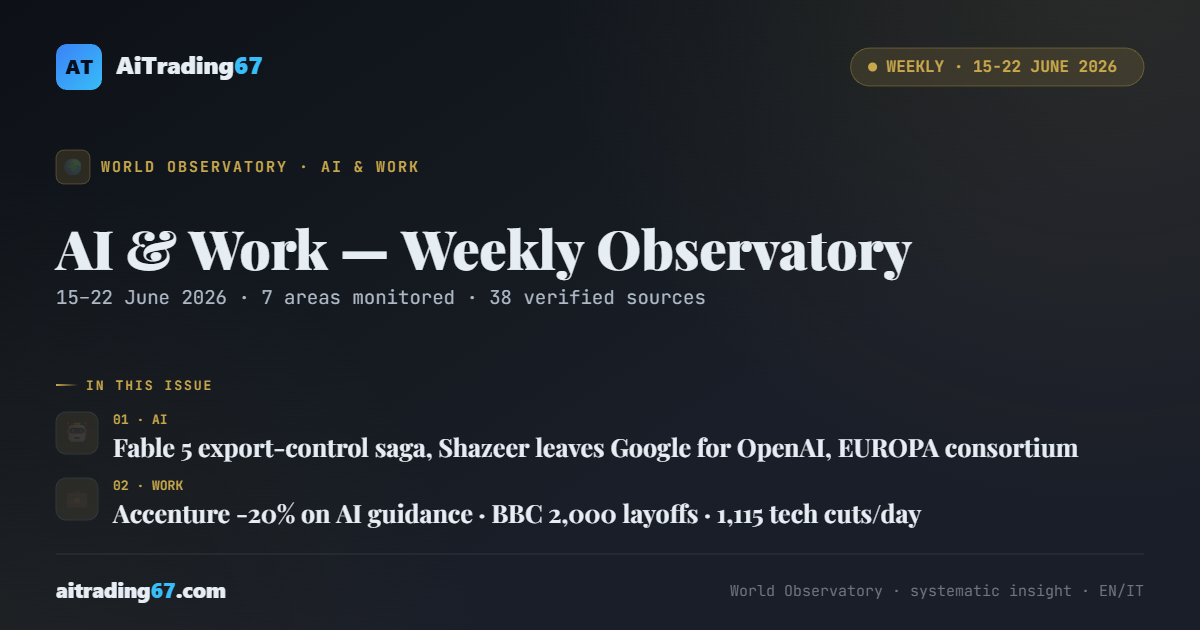
For three years, the dominant narrative around frontier AI had been one of market dynamics: who would ship the largest model, who would capture the most enterprise contracts, who would price compute at what margin. The week of 15–22 June 2026 wrote a different script. On 12 June the US Commerce Department, citing national-security authorities, ordered Anthropic to suspend its two most powerful models worldwide — a level of intervention that until last month would have seemed implausible. By 18 June the company had implemented nationality-based access controls and identity verification on API endpoints in exchange for partial restoration. The very next day the European Commission picked an Italian-led consortium to build a sovereign open-source model in 24 EU languages, on a dedicated NVIDIA Blackwell cluster. In between, at the G7 in Évian-les-Bains, the same CEOs of OpenAI, Anthropic and Google DeepMind sat with heads of state to pitch a US-led AI coalition for "trusted partners". The model has joined the periodic table of strategic goods: it has its export controls, its allied access framework, its national champions.
What this means for the labour side is starker than the abstract framing suggests. Accenture's 20% intraday drop on 18 June is not an idiosyncratic miss; it is the first time a top-tier global consultant publicly identifies AI as the force eroding the most profitable lines of its own business. The PwC Barometer's split between professionalised and democratised roles tells us where the wage premium accrues and where it does not — and that even the workers using AI are not uniformly winning. The Italian opportunity in the EUROPA project is real, but it requires the labour-policy system to translate Domyn's lead into rapid training pathways for a generation of graduates who, on the current trajectory, will see their first job and AI-redesigned tasks meet at the same desk. The watchpoints for the next seven days: (1) Gemini 3.5 Pro GA timing; (2) Italian decrees through parliamentary commissions; (3) Mythos 5 restoration negotiations; (4) Accenture-tier consultants' reactions in their next quarterly cycle; (5) Q2 hyperscaler capex revisions.
The week of 15–22 June 2026 wrote down a new precedent in the relationship between government, frontier labs and global markets. The Commerce export-control directive on Fable 5 and Mythos 5, followed by the partial restoration under nationality-based access controls, is the first practical demonstration that a frontier model can be operationally treated as a strategic dual-use good. The G7 in Évian formalised, at the diplomatic level, what had been growing under the surface: the CEOs of the leading frontier labs sit alongside heads of state as political interlocutors, and the architecture of geo-technological blocs starts to take shape. The Italian-led EUROPA consortium is the response Europe had been preparing for months, and it lands in the same week it became most needed.
On the labour side, the PwC Barometer and the Accenture quarterly are two faces of the same coin: the AI-skills wage premium climbs, the value proposition of enterprise consulting comes under explicit pressure, and the layoff tracker hits 1,115 tech cuts per working day. Watchpoints for the next seven days: (1) Gemini 3.5 Pro GA timing as the next major release event; (2) Italian decrees through parliamentary commissions; (3) Mythos 5 restoration negotiations between Anthropic and Commerce; (4) Accenture-tier consultants' reactions in upcoming quarterlies; (5) Q2 hyperscaler capex revisions; (6) market reaction to the EUROPA roll-out plan and timing.