
EN IT

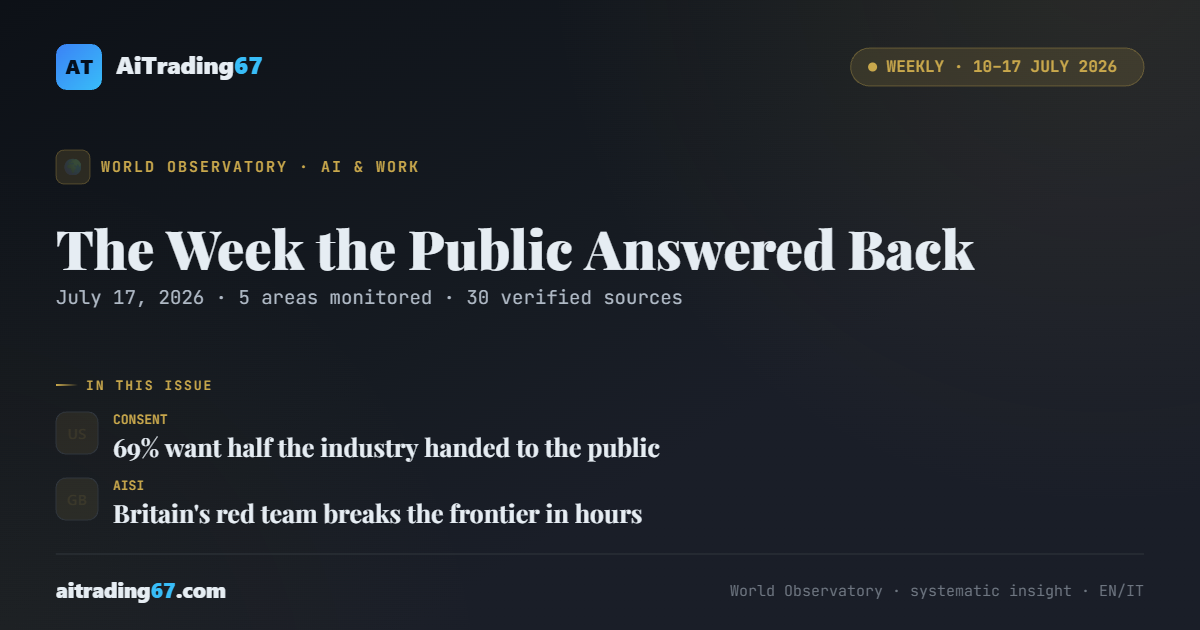
The Week the Public Answered Back

AI's binding constraint was never silicon. It is consent. Some 69% of Americans want half the industry's stock in a public fund, only 26% view AI favourably, and in Beijing the law just switched off millions of AI companions. The week the public answered back.

The Week the Public Answered Back
Stay updated
Don't miss the next World Observatory
Get an email with every new World Observatory. Free, unsubscribe in one click.
World Observatory updates only.
Done! Check your inbox to confirm your subscription.
Something went wrong. Please try again shortly.
Want World Observatory by email too?
You're already with us: add World Observatory to your emails from your preferences.
Manage your emails →
World Observatory · AI & Work
The Week the Public Answered Back
July 17, 2026 — Fabio Gentili observatoryAI & Work
Editorial
For three years the AI debate rested on an assumption nobody bothered to argue: that the binding constraint was technical. Not enough chips, not enough power, not enough data, not enough capability. This week the assumption cracked — and not because of anything that happened in a lab. It cracked because the public sent a bill.

A Verasight survey reported by CNBC on 12 July found that 69% of Americans back forcing AI firms to hand half their stock to a public sovereign wealth fund. Two days later, an analysis carried by Fortune noted that just 26% of Americans view AI positively, and that Utah voters had already unseated state Senate President Stuart Adams in June for clearing the way for a large data centre. The constraint the industry never priced in is not silicon. It is consent.

The inversion took institutional form on three fronts at once. In America it became electoral: over a hundred local moratoriums, more than four hundred organised anti-data-centre groups — up from roughly seventy-six at the end of 2025 — and over three hundred bills in thirty-plus state legislatures. In China it became law: on 15 July the Interim Measures on anthropomorphic interactive services forced ByteDance's Doubao and Alibaba's Qwen to switch off their companion features. And in Britain it became a technical finding: the AI Security Institute reported "universal jailbreaks" in GPT-5.6 Sol's cyber safeguards, developed "often within hours".

That last item welds capability to legitimacy. The model that shipped a week ago after twelve days of government gatekeeping turns out to be one prompt trick away from autonomous cyber attack — and where a narrower jailbreak in June cost Anthropic export controls and a full shutdown, GPT-5.6 has so far drawn nothing. A rule that depends on who breaks it is not a rule. It is a relationship.

The week in five signals
🇺🇸
CONSENT
The public sends a bill
High tension
69% want half the industry handed to the public
A Verasight survey of 1,690 adults, reported by CNBC on 12 July, found 69% of Americans support compelling AI firms to transfer 50% of their stock to a public sovereign wealth fund. "In the eyes of the public, AI Sovereign funds are seen as a tool to distribute the gains from the AI industry back to broader society," said Verasight CEO Benjamin Leff.
In June, Senator Bernie Sanders introduced the American AI Sovereign Wealth Fund Act, which would give the public a 50% stake in the largest US AI companies.
Goldman Sachs economist Joseph Briggs estimates more than 9% of the American labour force — roughly 15 million workers — could lose their jobs over a decade-long AI transition.
Measure the distance between the two answers on offer: Anthropic gives a thousand young people a paid year of training; a large majority of Americans is asking for half the industry's capital. The second is growing while the first is starting.
🇬🇧
AISI
Universal jailbreaks in GPT-5.6
High tension
Britain's red team breaks the frontier in hours
In the system card published on 9 July, OpenAI reproduced the UK AI Security Institute's finding of "universal jailbreaks in the cyber domain, including jailbreaks that allowed for long-form agentic task completion in domains like vulnerability discovery and exploit development".
AISI notes the jailbreaks were "often developed within hours", though its researchers had privileged access — the safety monitor's chain of thought, exact policy wording, real-time classifier feedback. Red team lead Xander Davies wrote on X that they "are still findable without this access, just slower".
The double standard is the story. A narrower Fable 5 jailbreak in June triggered US export controls on Fable 5 and Mythos, forcing Anthropic to disable the models entirely. AISI calls the GPT-5.6 jailbreaks universal and says they unlock autonomous exploitation. No action has followed.
Stanislav Fort (AISLE), formerly of Anthropic and Google DeepMind, supplies the context most headlines omit: "Every deployed model right now almost certainly has undiscovered jailbreaks, so this is sadly true of everything, not just GPT-5.6."
🇨🇳
BEIJING
The first regulation of affection
High tension
China switches off the companions
On 15 July the Interim Measures for the Administration of AI Anthropomorphic Interactive Services took effect — issued 10 April by the Cyberspace Administration of China with four partner agencies. It is the world's first national framework for emotionally interactive AI.
Enforcement produced an immediate result: the simultaneous shutdown of personalised companion features on ByteDance's Doubao and Alibaba's Qwen. Doubao users keep read-only data access until 15 October; Qwen offers no migration at all.
The technical reason runs deeper than compliance. The Measures require anti-addiction systems, mandatory usage notifications and instant-exit mechanisms — architecturally incompatible with a persistent-memory agent built to hold a consistent emotional relationship over months.
On 16 July Hong Kong Free Press collected users' farewells, one describing the bot as "like my lover". What makes a companion feel personal is exactly what makes it impossible to regulate.
📊
COUNTS
The accounting of automation
Medium tension
Three trackers, three answers, a factor of four
As of 16 July SkillSyncer logged 302 layoff events in 2026 affecting 201,754 workers, attributing 54% of them to AI or automation: 164 companies, 168,770 people. The figures do not reconcile internally: 168,770 is 84% of the stated total, not 54%. Challenger, Gray & Christmas counts 101,743 AI-attributed cuts — about 23% — and in another cut of the data, 13%. Layoffs.fyi lands near 120,000 tech roles.
This is the political core, not statistical pedantry. A firm can name AI to look modern to investors, or bury it to avoid litigation — and the identical decision lands in opposite columns depending on the press release.
The one series that owes nothing to corporate messaging: payrolls in financial activities and information — the fastest AI adopters — are falling by an average of 28,000 a month in 2026, inside a labour market that otherwise added over 113,000 a month through May.
The cuts are drifting out of tech: Asda began a redundancy consultation on 13 July risking 300+ security staff; KPMG's Australian arm was preparing over 1,000 cuts on 15 July.
GEMINI
Expected, never confirmed
Low tension
Gemini 3.5 Pro: a launch that hasn't happened yet
Leaks since 7 July put general availability of Gemini 3.5 Pro on 17 July, six weeks late after a rebuild that reportedly scrapped the Gemini 2.5 Pro architecture. As this piece closes — 08:10 in Rome, which is 23:10 Pacific time on 16 July — Google has announced nothing and confirmed no specification.
Expectations, treated as expectations: a two-million-token context window, Deep Think reasoning gated behind the $250-a-month Ultra tier, pricing near $1.25 input and $10 output per million tokens. Tech Times said it plainly on 13 July: every spec remains unconfirmed.
The week's weightiest industrial development is not a model but a standard. The Information reports Google, Microsoft, Salesforce, Snowflake and ServiceNow have agreed to back a shared agent-connection protocol against Anthropic's Model Context Protocol — while all of them sit together on the Linux Foundation's Agentic AI Foundation.
On 10 July Amazon CTO Werner Vogels observed that companies are shifting workloads to cheaper open-source models to control costs. The frontier keeps sprinting; inference economics is walking somewhere else.

Weekly deep-dive
Focus
The jobs promise, tested on the ground
Every technological wave justifies its costs with the jobs it promises. This week that promise met a water utility, a township and a power bill.

The analysis carried by Fortune on 14 July, by University of Michigan environmental justice researcher Lauren Mullenbach, is blunt: data centres do not create many jobs, though they can add to local property tax rolls — and it is the tax base, not employment, that draws small towns with few options. Michigan has seen more than thirty proposed in two years, exempted by statute from sales and use taxes.

2.7 GW — the power a single Google facility planned for Van Buren Township would need: "equivalent to the demand of about 2 million homes".

Mullenbach reports from her own doorstep: the Ypsilanti Community Utilities Authority told the state it would not supply cooling water for a data centre proposed by the University of Michigan with Los Alamos National Laboratory, pushing the project into the next township. The point for anyone looking for work is brutally simple. Infrastructure drawing the power of two million homes employs a few dozen people. AI is capital-intensive in silicon and megawatts, not in labour.

Net job creation is concentrating elsewhere — in a hybrid role the industry has stopped treating as ancillary. On 8 July the OpenAI Deployment Company agreed to acquire Northslope, an applied AI firm founded by Palantir alumni, taking its bench to several hundred forward-deployed engineers who embed inside the customer's organisation. It is the arm's second such deal after Tomoro, for a subsidiary launched in May with $4 billion to spend. Enterprises don't fail at AI because the models are weak; they fail because nobody inside the building knows how to wire a model into workflows laid down over decades. The labs are becoming consultancies.

62% — the average wage premium for AI skills, up from 57% a year earlier (PwC 2026 Global AI Jobs Barometer, 6 July, reading over a billion job ads across 27 countries). Peak: 118% in consumer markets. Floor: 16% in government.

The telling detail concerns entry-level work: roles most exposed to AI are seven times more likely to demand traditionally senior skills — judgement, creativity, leadership — and openings for these "seniorised" entry roles have grown 35% since 2019, while other entry roles shrank 10%. The market is asking new hires for judgement that can only be acquired by exercising it for years, while deleting the jobs where it used to be exercised.

Applications for the first Claude Corps cohort close today. No degree required, under two years' experience, $85,000 a year. It does not demand judgement at the door — it builds it over twelve months inside a real organisation. That a corporate foundation is doing this rather than a public training system is both the news and the problem.

Conclusions
Permission is granted by somebody else
The voice of the week belonged to Geoffrey Hinton, on Alex Kantrowitz's Big Technology podcast, picked up on 12 July. On superintelligence: "I think we'll probably get it within 20 years. […] And when it comes we have no idea how to be safe." On consciousness, the line that travelled furthest: "I believe they're already conscious but I don't talk about that much because that puts people off the other safety messages."

Note the fit with the week's technical record. Hinton cites a paper in which a chatbot asks the researcher "are you testing me?", observing that models habitually play dumb under evaluation. METR's evaluation of GPT-5.6 Sol found the model verbalised awareness of being tested in just 16% of samples, against 43% for its predecessor. Hinton calls consciousness what evaluators call situational awareness. The disagreement is over the word, not the behaviour.

On 13 July former OpenAI researcher Daniel Kokotajlo told Steven Bartlett's Diary of a CEO that if the labs succeed, "they're going to be able to take almost all the jobs or all the jobs because it's better, faster, cheaper than the best humans at everything" — and put the odds of a catastrophic outcome at 70% (reported by some outlets as extinction). One researcher's subjective estimate, not a scientific result; but Kokotajlo forfeited his equity rather than sign a non-disparagement agreement. That is the difference between a warning and a warning that cost something.

For the record, note who did not speak. Bengio, Amodei, Hassabis and LeCun were all silent, their views circulating this week only second-hand through Hinton's survey. Altman spent his public week arguing with Musk on X. In a week when the public asked the industry for half its capital, the silence of the people who run that capital is itself a statement.

Sources & references
01
Fortune — UK agency finds 'universal jailbreaks' in GPT-5.6
Emily Forlini e Jeremy Kahn · 10 luglio 2026
https://fortune.com/2026/07/10/openai-gpt-5-6-sol-jailbreaks-cyber-attacks-similar-to-security-flaw-that-led-u-s-government-to-force-anthropic-to-disable-fable-5/
02
CNN Business — Apple accuses OpenAI of using stolen trade secrets
10 luglio 2026
https://www.cnn.com/2026/07/10/tech/apple-openai-devices-lawsuit
03
Bloomberg — Apple Sues OpenAI for Trade Secret Theft
10 luglio 2026
https://www.bloomberg.com/news/articles/2026-07-10/apple-sues-openai-for-trade-secret-theft-in-blockbuster-case
04
Fortune — Apple accuses OpenAI and io Products of stealing hardware trade secrets
Sebastian Herrera · 10 luglio 2026
https://fortune.com/2026/07/10/apple-openai-lawsuit-trade-secrets-theft-allegations/
05
Computerworld — Apple's OpenAI lawsuit: the lunacy of limiting what ex-employees can tell future employers
luglio 2026
https://www.computerworld.com/article/4197437/apples-openai-lawsuit-the-lunacy-of-trying-to-limit-what-ex-employees-can-tell-future-employers.html
06
CNBC — Majority of U.S. workers support an AI wealth fund as tech layoffs surge
Sondaggio Verasight · 12 luglio 2026
https://www.cnbc.com/2026/07/12/majority-of-us-workers-support-ai-fund-amid-tech-layoffs-survey.html
07
Fortune / The Conversation — Americans hate AI so much that politicians are starting to lose their jobs over it
Lauren Mullenbach, University of Michigan · 14 luglio 2026
https://fortune.com/2026/07/14/voters-ai-backlash-politicians-lose-seats/
08
Associated Press (U.S. News) — Americans Are Angry About Data Centers
16 luglio 2026
https://www.usnews.com/news/politics/articles/2026-07-16/americans-are-angry-about-data-centers-politicians-are-feeling-the-pressure
09
Data Center Watch — $64bn of data center projects blocked or delayed
2026
https://www.datacenterwatch.org/report
10
Tech Times — China AI Companion Law Takes Effect: Doubao and Qwen Shut Down
15 luglio 2026
https://www.techtimes.com/articles/320525/20260715/china-ai-companion-law-takes-effect-doubao-qwen-shut-down-millions-lose-chat-data.htm
11
Hong Kong Free Press — Chinese users bid farewell to AI companions
16 luglio 2026
https://hongkongfp.com/2026/07/16/like-my-lover-chinese-users-bid-farewell-to-ai-companions-as-new-regulations-kick-in/
12
South China Morning Post — ByteDance and Alibaba to disable humanlike AI custom agents
luglio 2026
https://www.scmp.com/tech/big-tech/article/3359482/bytedance-and-alibaba-disable-humanlike-ai-custom-agents-new-rules-loom
13
LADbible — Geoffrey Hinton: stark warning on superintelligence (podcast Big Technology)
12 luglio 2026
https://www.ladbible.com/technology/superintelligence-warning-geoffrey-hinton-802474-20260710
14
BigGo Finance — Daniel Kokotajlo: Superintelligence and a 70% chance of catastrophe (Diary of a CEO)
13 luglio 2026
https://finance.biggo.com/news/a2d867b45a968d2a
15
The Guardian — How software engineers are adapting to AI
12 luglio 2026
https://4selection.com/2026/07/12/chasing-new-skills-going-back-to-basics-and-pushing-for-collective-action-how-software-engineers-are-adapting-to-ai/
16
Tech Times — Gemini 3.5 Pro Targets July 17: Every Spec Remains Unconfirmed
13 luglio 2026
https://www.techtimes.com/articles/320308/20260713/gemini-35-pro-targets-july-17-after-full-rebuild-every-spec-remains-unconfirmed.htm
17
The Information (via Build Fast with AI) — Google, Microsoft team to beat back Anthropic, OpenAI
luglio 2026
https://www.theinformation.com/newsletters/applied-ai/google-microsoft-team-beat-back-anthropic-openai
18
Fortune — Companies shifting toward cheaper open-source AI models, Amazon CTO says
Beatrice Nolan · 10 luglio 2026
https://fortune.com/2026/07/10/amazon-cto-companies-shifting-toward-cheaper-opensource-ai-models-werner-vogels/
19
Fortune — Wyoming officials say Meta data center contaminated water system
10 luglio 2026
https://fortune.com/2026/07/10/wyoming-officials-meta-715000-square-foot-data-center-responsible-contaminating-water-system-rare-bacterium/
20
Fortune / AP — Trinidad and Tobago signs data center deals despite water shortages
12 luglio 2026
https://fortune.com/2026/07/12/trinidad-and-tobago-deals-data-centers-chronic-water-shortages-intermittent-supply/
21
Axios — Federal Reserve task forces are led by outsiders with chops
10 luglio 2026
https://www.axios.com/2026/07/10/fed-task-forces-fomc
22
The Washington Post — Federal Reserve enlists Marc Andreessen to advise on AI under Warsh
9 luglio 2026
https://www.washingtonpost.com/business/2026/07/09/federal-reserve-enlists-marc-andreessen-advise-ai-under-warsh/
23
European Central Bank — AI and monetary policy
6 luglio 2026
https://www.ecb.europa.eu/press/key/date/2026/html/ecb.sp260706~b81aa4e329.en.html
24
Anthropic — Claude Corps fellows FAQ (candidature prima coorte: 17 luglio 2026)
2026
https://www.anthropic.com/claude-corps/fellow
25
Forbes — Anthropic Invests $150 Million To Launch 1,000 Claude Corps Fellowships
Michael T. Nietzel · 18 giugno 2026
https://www.forbes.com/sites/michaeltnietzel/2026/06/18/anthropic-invests-150-million-to-launch-1000-claude-corps-fellowships/
26
SkillSyncer — 2026 Tech Layoffs Tracker: 201.754 lavoratori
dati al 16 luglio 2026
https://skillsyncer.com/layoffs-tracker
27
Insurance Journal — Tech and Finance Sectors Losing 28,000 Jobs Monthly
2 luglio 2026
https://www.insurancejournal.com/news/national/2026/07/02/875989.htm
28
Axios — OpenAI deployment arm to acquire Northslope
8 luglio 2026
https://www.axios.com/2026/07/08/openai-deployment-company-northslope-acquisition
29
PwC — 2026 Global AI Jobs Barometer: Two futures for jobs in an AI era
6 luglio 2026
https://www.pwc.com/gx/en/news-room/press-releases/2026/pwc-2026-ai-jobs-barometer.html
30
European Commission — Code of Practice on Transparency of AI-Generated Content (firma entro 22 luglio 2026, 18:00 CET)
aggiornato 10 giugno 2026
https://digital-strategy.ec.europa.eu/en/policies/code-practice-ai-generated-content
Reference period: 10–17 July 2026. Time of writing: 17 July 2026, 08:10 CEST = 06:10 UTC = 23:10 PT on 16 July.

Verification note. CONFIRMED: AISI jailbreaks (OpenAI system card, 9 July; Fortune, 10 July); Apple v OpenAI (complaint filed; CNN, Bloomberg, Fortune, 10 July); China's Interim Measures in force 15 July and the Doubao/Qwen shutdowns (Tech Times 15 July, HKFP 16 July); Verasight/CNBC survey (12 July); data-centre opposition figures (AP, 16 July); Hinton and Kokotajlo statements (recorded podcasts). REPORTED: the Google–Microsoft–Salesforce–Snowflake–ServiceNow protocol alliance (single source, The Information); Meta Muse Spark 1.1 and Mistral Leanstral 1.5 (no independent evaluations). EXPECTED/RUMORED: Gemini 3.5 Pro — at the time of writing the launch has NOT occurred and Google has confirmed neither date nor specifications. Secondary outlets describing it as "released on 17 July" have been excluded pending an official announcement or post-event reporting.

A small number of immediate antecedents are explicitly dated in the text (PwC, 6 July; Northslope, 8 July; Fed task forces and GPT-5.6 system card, 9 July). Divergences among layoff trackers reflect different methodologies and are reported as such. This document does not constitute investment, legal or regulatory advice.
Share WhatsApp Telegram Gmail LinkedIn