
Tech in the US, banks in Europe: energy foots the bill
Macro context
The underlying backdrop remains friendly to risk. Equity volatility is contained, well below alarm levels, and bond-market volatility has fallen decisively over recent weeks: two signals that usually accompany markets in a mood to climb. There is one detail worth watching, though. The gauge measuring demand for protection against extreme downside has risen: the more cautious investors are buying parachutes even as the market advances. It is not an alarm, but it is the way large operators say they trust the move — though not entirely.
On commodities and currencies the message is rougher. The dollar has regained ground and shows signs of strengthening, a headwind for anyone exposed outside the United States. Gold is in critical territory, sharply off its highs: a move that often accompanies the return of risk appetite, but which here carries the intensity of a genuine correction. Oil is weak and falling markedly, and the index of shipping rates — a raw thermometer of global trade — is also declining. Taken together, these pieces sketch a real economy that is slowing just as equity markets celebrate technology.
And here lies the overall reading of the rotation: the market is not buying everything, it is buying growth. Strength concentrates where there is a story of expansion — technology on both shores — and abandons the sectors tied to the commodity cycle and to defense. It is a selective rotation, not a wave that lifts all boats.
US sectors
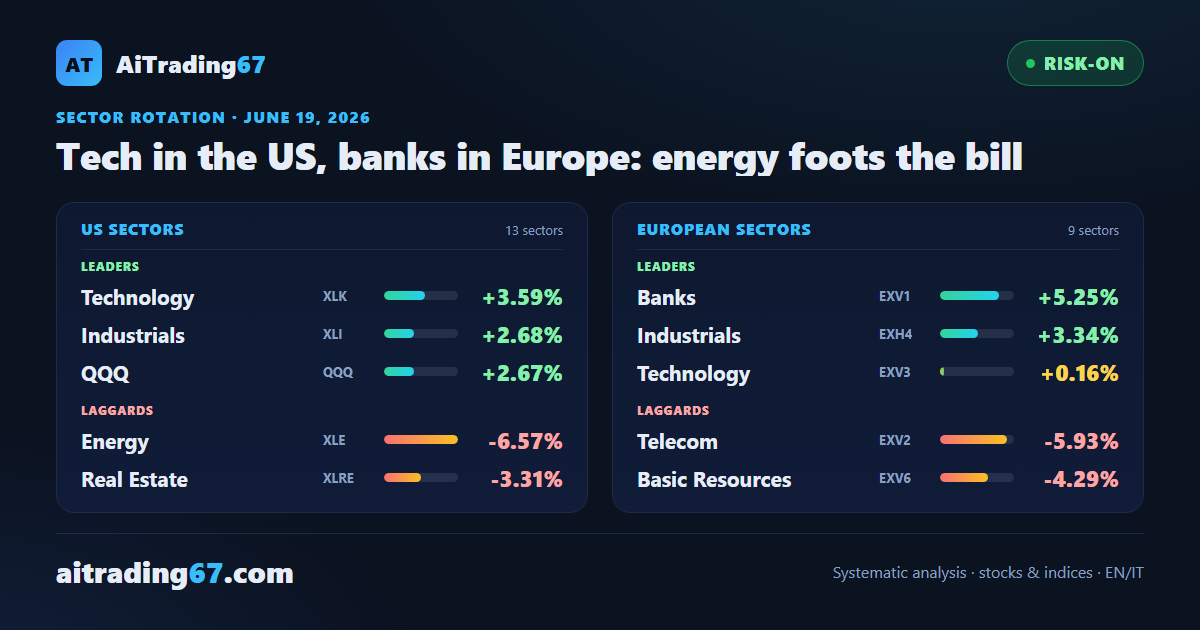
In the United States the script is clear: technology commands, industrials follow, everything else struggles. XLK closes the week at +3.59% and is the sector with the hottest engine, an RSI at 74.7 placing it in intense-buying territory and an ADX at 32.1 certifying a strong, directional trend rather than a random bounce. Relative strength is rising and the MACD histogram stays positive at 3.86: the sector pulls, and it does so with conviction.
Behind technology, industrials push through. XLI posts +2.68% with an RSI at 69.5 and relative strength also climbing — a sector that, when it accelerates, signals confidence in domestic demand and capital spending. It is the second pillar of the American week. In between sits a group of lukewarm sectors, slightly up but without real direction: utilities at +0.52%, consumer discretionary at +0.48% with a neutral RSI at 51, financials at +0.43%. The latter stays in a bullish regime with positive MACD, but the ADX at 12.9 says the trend is feeble, more drifting than driving.
The bottom of the table is where the pressure concentrates. Materials slip slightly to -0.71%, communications retreat 1.97% with an RSI down to 41 and falling relative strength, healthcare sheds 2.87% and consumer staples 2.94%: the defensive bloc is the great exclusion of the week, all in a bearish regime. Real estate loses 3.31%. But the outright laggard is energy: XLE drops 6.57%, fully bearish, with a very high ADX at 36.0 that here certifies the strength of the downward move and an RSI at 48.4 that still has room to fall. It is the signature of weak oil bleeding into the sector.
European sectors
In Europe the lead belongs to the banks. EXV1 closes at +5.25%, the highest performance in the entire sector universe, with an RSI at 68.4 and an ADX at 26.1 confirming a solid trend with rising relative strength. It has been the continent's structural engine for months, and this week it returns firmly to the front.
Right behind come industrials: EXH4 posts +3.34% with an RSI at 59.6 and rising relative strength, a sign of appetite reaching beyond finance alone. Technology, by contrast, catches its breath: EXV3 closes barely positive at +0.16%, but beneath the surface it remains the hottest sector for momentum, with an RSI at 74.9 — the highest of all sectors — and a robust MACD at 1.91. Relative strength is cooling, a sign that the week was one of consolidation after a long run, not a reversal.
The lower half tells the same selectivity seen across the ocean. Utilities give up 0.83%, with an ADX at 33.7 measuring a well-defined trend. Healthcare retreats 2.14% in a bearish regime, autos lose 3.32% with a weak RSI at 41.1. Heavier still are oil & gas, -3.48% with a high ADX at 31.6 marking a well-defined downtrend, and basic resources, -4.29% with an ADX at 35.2. But the real dead weight in Europe is telecoms: EXV2 loses 5.93%, the worst figure on the continent, with an ADX at 30.5 certifying how directional the pullback is. Note a healthy contrast: industrials rise on both shores, while the sectors tied to the commodity cycle and to defense retreat.
Cross-region comparison & broad indices
The comparison between the two shores returns an image that is at once mirrored and divergent. The same underlying logic — the market buys growth and finance, sells the cycle and defense — but two different leaders: in the United States technology commands, in Europe the banks. In the US leadership is concentrated and hierarchical (tech and industrials pull, the rest retreats); in Europe the push is more diffuse, with banks and industrials leading and technology consolidating while still holding the highest momentum of any sector.
The most instructive contrast is not in the sectors themselves — industrials rise on both shores, energy and defensives retreat everywhere — but in what leads the charge: the United States leans on technology, Europe on finance. Two different engines of the same risk appetite. For anyone watching the broad baskets it is a detail that matters: the slowdown in the real economy — weak oil, falling freight rates — bites the cyclical sectors of both regions.
For the broad indices the implications are direct. The crushing weight of technology on the Nasdaq and the S&P 500 explains why QQQ and SPY stay supported despite the fragility of the defensives: as long as XLK pulls, the index pulls. On the European side, the banks' run (EXV1 +5.25%) directly supports finance-heavy baskets such as the MIB, which has long ridden this sector; technology's pause (EXV3, +0.16%) should be read as a breather, not a breakdown, given the momentum still in place. The week's clean reading: the market buys growth and finance and sells the cycle, on both shores. As long as banks and technology hold, the rotation remains an internal shift and not an alarm bell; but tense gold and falling energy are the threads to keep an eye on.