
Sector rotation: value cyclicals and banks take the lead as technology pauses
Macro context
The macro backdrop stays broadly constructive, but something is shifting beneath the surface. Equity volatility is contained, with no sign of stress; bond-market volatility remains low, though it has started climbing again over the past month. That is the most telling signal: investors are buying protection once more, as a downside-hedging gauge sitting in elevated territory confirms. This is not fear, it is caution - and caution, with indices near their highs, pushes capital toward what is sturdier and cheaper.
The rest of the backdrop helps read the rotation. Market breadth is improving, a sign that participation is no longer concentrated in a handful of names. The dollar is steady, its momentum slowly firming. Oil is the standout with a strong monthly advance, even as its thrust cools, and rising shipping rates point to real demand that is still alive. Gold, by contrast, sits in a weak consolidation. Put together, these pieces sketch a market rotating from growth into value: energy, industry and finance are gathering the flows, technology and discretionary consumption are handing them back. The asymmetry between the United States and Europe is not in the direction of the rotation - identical - but in its intensity: in Europe the pendulum has swung further toward the cyclicals.
US sectors
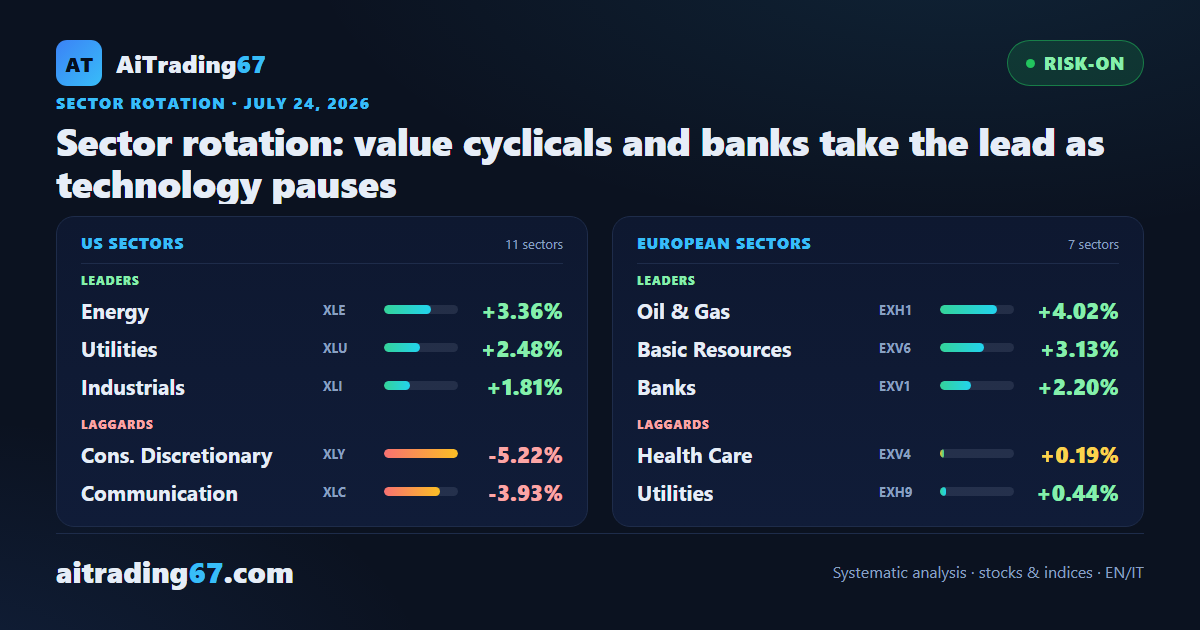
In the United States, leadership has passed to the value cyclicals. Energy (XLE) leads with +3.36%, backed by a trend that is taking shape: an ADX of 28.6 and an RSI of 60.4 describe a directional move rather than a one-off bounce, with relative strength rising against the index. Right behind sit utilities (XLU, +2.48%) and industrials (XLI, +1.81%), the latter with an RSI of 66.2 that signals robust participation. Rounding out the strong group are materials (XLB, +1.44%) and real estate (XLRE, +1.17%), the latter the only sector in the most favorable compression band and with rising relative strength: an interesting candidate for anyone hunting an entry on a segment still lagging in the cycle.
The heart of the week, though, lies elsewhere: in the engine that has stalled. Technology (XLK) closes essentially flat at +0.17%, its MACD histogram still below zero (-0.34) despite an elevated ADX of 31.1 - the underlying trend holds, but the short-term push has run out. Financials (XLF, +0.09%) also mark time despite a stretched RSI of 66.5. And at the bottom comes the real bill: communications (XLC) shed -3.93% and consumer discretionary (XLY) collapse -5.22%, both in a bearish regime on their moving averages with falling relative strength, RSIs sunk below 41. Even consumer staples (XLP, -1.24%) retreat, confirming this is not a flight to pure defensives but a targeted rotation toward the cyclicals of the old economy. For anyone eyeing swing trading setups, the two poles are here: confirmed strength in energy and industrials, structural weakness across growth communications and consumption.
European sectors
In Europe the same story unfolds in sharper tones. Out front is oil and gas (EXH1) with a decisive +4.02%, lifted by the crude rally and paired with a trend under construction, an ADX of 25.6 and an RSI of 60.3. Basic resources follow closely (EXV6, +3.13%): the contrast is striking between a moving-average regime still bearish and a rising relative strength with an ADX of 26.2 - a sector that is turning, with price leading the moving averages in changing course.
The true European protagonist, however, is banks (EXV1). The +2.20% does no justice to the quality of the move: an RSI of 66.0 and an ADX of 30.2 describe the cleanest, most directional trend across the whole continental landscape, with relative strength climbing. It is the most convincing leadership of the week on either side of the Atlantic. Behind them, industrials (EXH4, +1.57%) and - more timidly - technology (EXV3, +0.54%), utilities (EXH9, +0.44%, with a notable ADX of 31.5) and health care (EXV4, +0.19%) tag along in loose order. European technology mirrors the American picture: relative strength formally rising, but a MACD histogram pinned to zero and no thrust. At the foot of the table, just as in the United States, sit the most punished sectors: automobiles (EXHG, -2.23%) and telecommunications (EXV2, -3.01%), both in a bearish regime, with declining relative strength and RSIs around 41. Europe's weak tail and America's look very much alike.
Cross-region comparison & broad indices
The two regions rotate in the same direction, but with different geometries. In the United States leadership stays more concentrated and more ambiguous: value cyclicals pull, yet technology's enormous weight - nominally still in trend - drains the shine from the picture the moment tech stalls. In Europe the rotation is broader and more convinced: energy, basic resources and banks form a wide value block, and bank leadership gives the move a backbone that the United States lacks.
The implications for the broad baskets are direct. The Nasdaq and the S&P 500 are weighted toward technology and large-cap growth: when that engine stalls, the indices slow even if half the sectors rise. It shows in the week's numbers - the S&P 500 vehicle sheds -0.59% and the Nasdaq 100 one drops -1.60%, the latter having just flipped its weekly reversal signal to the downside. At the other end, a bank-heavy market such as Italy's benefits directly from financial leadership, and more broadly the European indices, less exposed to tech growth, digest this phase better. The operational read is simple: as long as technology stays flat, strength is to be found in value cyclicals and banks, in Europe more than in the United States. That is where price action confirms the trends, and that is where this week's best setups live.