
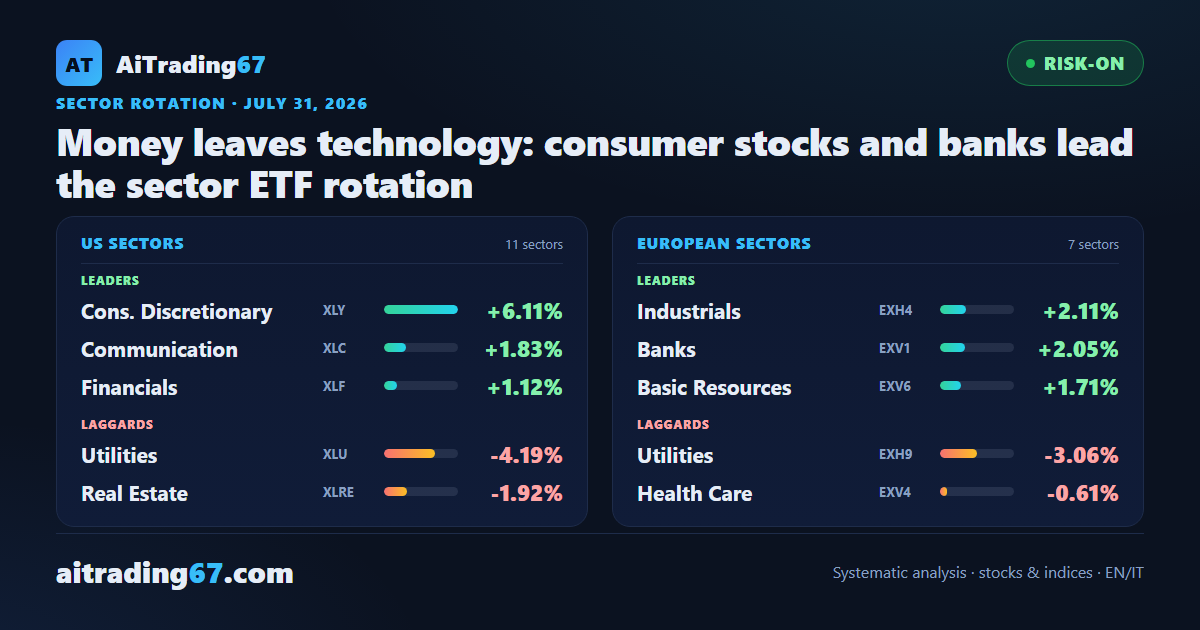
Money leaves technology: consumer stocks and banks lead the sector ETF rotation
Macro context
The macro backdrop stays permissive, with one detail worth watching. Implied equity volatility is subdued, and the premium paid to hedge tail events has actually eased over the past month. The awkward signal comes from fixed income: bond volatility, though still low in absolute terms, has climbed sharply over the last four weeks. That kind of move tends to lead shifts in sector leadership far more reliably than the equity index itself.
Breadth is improving without being full: more names are taking part in the advance than a month ago, and that is the ground on which rotation thrives. The dollar is flat, its underlying structure weakening. Gold sits in critical territory, pinned near the bottom of its six-month range; read alongside oil's firm recovery, it describes a market pricing growth and industrial commodities rather than protection.
The asymmetry between the two regions is not about direction but composition: both are rising, and in both the things doing the rising are no longer the ones that were rising a month ago.
US sectors
Consumer discretionary is the headline. XLY closes at +6.11%, the widest move in the basket, from a still-modest technical position — RSI 50.2, ADX 14.3 — the profile of a sector starting out rather than one running out of road: the MACD histogram has flipped its slope and the moving-average regime has turned bullish again. Behind it, communications in XLC at +1.83%: the regime is still bearish and RSI, at 43.2, the lowest in the group. A laggard catching up, not a leader.
Financials are the sturdiest case: XLF gains 1.12% with RSI at 68.5, the highest in the US basket, a firmly positive MACD and a bullish regime. The only American sector combining strength and structure without cracks.
The negative surprise is technology. XLK gives up 0.30%, small in absolute terms, but its MACD histogram deteriorated more than any other sector's, with the highest ADX at 29.1 and relative strength fading. A trend still directional that has begun to turn: the most important data point of the American week.
The tail is crowded with heavy cyclicals and rate-sensitive defensives: utilities in XLU lose 4.19% and drop out of the bullish regime, real estate XLRE sheds 1.92%, materials XLB 1.62% with an already bearish regime, industrials XLI 1.54% with cooling momentum. Health care and energy sit flat; the one defensive holding up is XLP, consumer staples, at +1.09%. Seven sectors out of eleven changed gear in seven days: a market reorganising itself, not one going down.
European sectors
European leadership is cleaner. Banks in EXV1 rise 2.05% with ADX at 31.0 — the most directional trend in the whole sector universe, the US included — RSI at 68.1 and rising relative strength. The MACD is positive and flat: no longer accelerating, but not giving way either.
Industrials in EXH4 are nonetheless the tidiest corner: +2.11% with an improving MACD histogram, rising relative strength, a bullish regime and an RSI at 57.4 that leaves room ahead. The only European sector improving on price, momentum and relative strength at once.
The biggest number on the board deserves caution. Automobiles in EXHG add 4.15%, yet the moving-average regime is still bearish, ADX at 10.2 is the lowest of the lot, and RSI at 47.4 has not cleared the midline. A bounce inside a weak frame: worth watching, too early to call a reversal.
Basic resources in EXV6 gain 1.71% with rising relative strength and ADX at 25.1, plugged into the industrial-commodity recovery. Oil and gas in EXH1 sit flat at 0.11%, though momentum is recovering sharply.
On the weak side, European technology follows the US script: EXV3 slips 0.23% with the second-sharpest momentum deterioration. Telecom in EXV2 gains 1.09% yet stays in a bearish regime, RSI at 43.0; health care in EXV4 eases 0.61%. And at the bottom, once more, utilities: EXH9 loses 3.06% with relative strength fading, despite an ADX still elevated at 29.7.
Cross-region comparison & broad indices
Two markets, two ways of rotating. In the US the rotation is broad and untidy: seven sectors out of eleven changed gear in a single week, leadership has passed from technology to consumer names, and none of the new leaders yet carries a defined trend — the highest ADX readings still sit on the sectors that are losing, not the ones that are gaining. Europe does the opposite: only three of nine sectors changed gear, and the leaders, banks and industrials, also carry the firmest trend structure.
There is one thing in common, and it is not minor: utilities are the worst sector in both regions, and in both technology has lost thrust. That is the signature of a market moving money towards cyclicality and real growth rather than towards yield.
The consequences for the broad baskets are already visible. The S&P 500 ends the week at +1.10% against the Nasdaq's +0.55%, with the Nasdaq's relative strength fading and the S&P's neutral: when the technology weighting turns into ballast, the more diversified index wins. In Europe the configuration rewards baskets heavy in banks and industry — the Italian market for its banking weight, the German one for industry and automotive — while the UK index collects the recovery in basic resources and energy.
The read is simple: until technology regains momentum, look for risk in the cyclicals, with utilities the thermometer to watch for the opposite signal.