
The week of the great rotation: out of chips, into defensives, healthcare and financials
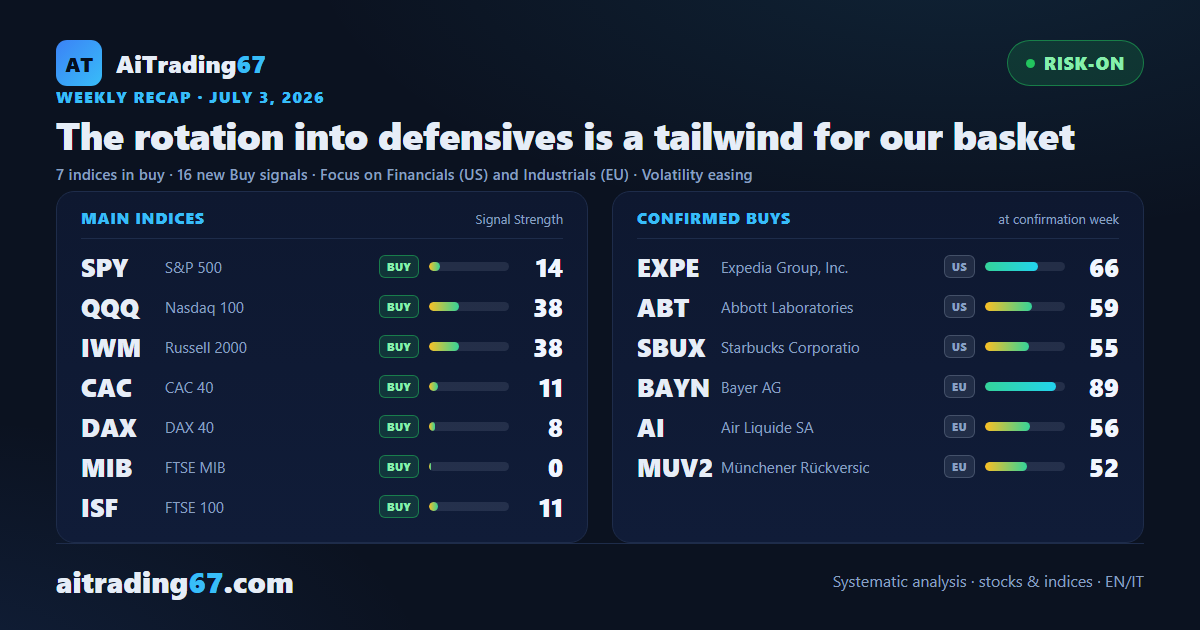
The rotation into defensives is a tailwind for our basket
7 indices in buy · 16 new Buy signals · Focus on Financials (US) and Industrials (EU) · Volatility easing
01
The week in view
The macro regime stays favorable — compressed volatility, broadening market breadth, stress gauges trending lower — and against that friendly backdrop the week carved out its dominant theme: a rotation within risk that kept capital invested. After a record first half led by semiconductors and artificial intelligence, chips took a heavy round of profit-taking while money shifted into defensives, healthcare, defense and financials. That is a tailwind precisely for this week's crop, which is defensive and European. Caution still applies: a soft jobs print and still-hawkish central bankers keep the rates knot open.
02
Macro regime
market contextRisk-On
The macro picture is broadly friendly: equity volatility has fallen more than a quarter over the past month (−26.5%) and bond volatility follows (−13%), tail risk recedes, and market breadth keeps widening (+9%) — the mark of a healthier rebound not pulled by a handful of names. The two tension threads to watch are the rates knot, with US and European central bankers still firm on inflation despite a slowing labor market, and the Italy-Germany yield spread, the only stress edging higher — no small detail for a book heavy in Italian banks. Gold and oil remain lower (−4.7% and −24% on the month), consistent with the return of risk appetite.
VIX
Neutral
MOVE
Favorable
DXY
Neutral
Breadth
Neutral
03
Main indices
7 Broad ETFsThe seven headline indices all remain buyers on the forming weekly, and after weeks of stitching, the short-term signal has finally aligned across all seven as France and Italy caught up. Signal strength, however, stays modest almost everywhere: a constructive but not explosive picture, where the rebound has repaired the structure without yet giving it thrust.
State Street SPDR S&P 500 ETF (SPY)Buy · open›
The S&P 500 stays in weekly buy mode, up 9.6% since entry at week 12, but with contained strength (14 out of 100): the structure holds on the right side, without the drive of a convinced push. The week added 2.2% and a daily double bottom offers support, even as the MACD stays in deterioration. It portrays an index that has stitched the short term back together but has yet to accelerate the medium term.
Signal Strength14 / 100
Invesco QQQ Trust Series I (QQQ)Buy · open›
The Nasdaq 100 is in buy mode (+9.8% since entry) with the group's highest strength, 38 out of 100: the signal holds despite the chip drop, because the tech complex split in two — semiconductors down, big software platforms up. The week was nearly flat (+0.9%) and price action has turned lower, but a daily double bottom held. A live buy, with an engine that has just switched horses.
Signal Strength38 / 100
iShares Russell 2000 ETF (IWM)Buy · open›
The small-cap Russell 2000 is in buy mode with strength 38 out of 100, level with the Nasdaq, and boasts the group's best gain (+13.9% since entry). The week took a breather (−0.8%) but the weekly RSI at 68 stays firm and the index works right up against its highs (less than 2 points away). It is the year's real leader among the indices, and the rotation toward value plays in its favor.
Signal Strength38 / 100
Multi Units France Sicav (CAC)Buy · open›
France's CAC 40 is in buy mode (+5.2% since entry), but with weak strength (11 out of 100): the structure is on the right side, conviction still faint. The week gained 1.6% with the MACD mildly improving and a sequence of higher lows on the daily chart, and the index is now glued to its all-time high. Paris was among the last venues to recover the short-term signal, and the modest strength reflects it.
Signal Strength11 / 100
Amundi DAX II UCITS ETF Acc (DAX)Buy · open›
Germany's DAX stays in buy mode (+4.1% since entry), with strength among the lowest in the group (8 out of 100): a technical buy devoid of thrust. Yet the week was the brightest among the indices (+4.6%), with the MACD improving and a bounce off the 20-day average that lifts the index back up against its all-time highs. The medium term still lacks momentum, but the week showed a sign of life.
Signal Strength8 / 100
Amundi FTSE MIB UCITS ETF (MIB)Buy · open›
Italy's FTSE MIB is in buy mode and still nicely in profit (+13.5% since entry), but with strength at 0 out of 100, the group's floor: the structure barely holds. The week added 2.9% and the weekly RSI at 71 flags a stretched market, with a bounce off the 20-day average. Milan stays supported by Italian banks, but the lack of momentum bears watching, especially with the Italian spread under slight tension.
Signal Strength0 / 100
iShares Core FTSE 100 UCITS ETF (ISF)Buy · open›
The UK's FTSE 100 is in weekly buy mode with modest strength (11 out of 100): contained conviction, but the UK was among the first to hold the short-term signal during the repair. The weekly RSI at 59 stays in neutral-to-positive territory, the index still has ample room toward its highs (over 10% away) and a daily double bottom for a base. A note of relative steadiness in a landscape of generally muted strengths.
Signal Strength11 / 100
04
Sector rotation
US · EuropeThe sector rotation captures the theme to the millimeter. At the top, European industrials lead (+5.55%), followed by US financials (+3.83%) and European banks (+3.72%), with communication services close behind (+3.22%): the sector face of the shift into banks, value and quality. At the bottom, energy (-1.15%) and real estate (-1.24%) drag in the US, while European telecoms slump (-3.34%), the continent's laggard. The message is clear: buy quality financials and industrials, sell energy and telecoms.
US sectors
XLF›
State Street Financial Select
rising · +3.83%
XLC›
State Street Communication Ser
rising · +3.22%
XLY›
State Street Consumer Discreti
rising · +2.40%
SPY›
State Street SPDR S&P 500 ETF
rising · +2.17%
XLV›
State Street Health Care Selec
rising · +2.12%
XLI›
State Street Industrial Select
rising · +1.50%
XLU›
State Street Utilities Select
falling · -0.95%
XLE›
State Street Energy Select Sec
falling · -1.15%
XLRE›
State Street Real Estate Selec
falling · -1.24%
European sectors
EXH4›
iShares STOXX Europe 600 Indus
rising · +5.55%
EXV1›
iShares STOXX Europe 600 Banks
rising · +3.72%
EXHG›
EXHG
rising · +3.54%
EXV4›
iShares STOXX Europe 600 Healt
rising · +3.07%
EXH1›
iShares STOXX Europe 600 Oil &
rising · +2.73%
EXH9›
iShares STOXX Europe 600 Utili
rising · +2.10%
EXV3›
iShares STOXX Europe 600 Techn
rising · +1.92%
EXV6›
iShares STOXX Europe 600 Basic
rising · +1.50%
EXV2›
iShares STOXX Europe 600 Telec
falling · -3.34%
05
Confirmed Buy signals
at the confirmation weekTen buys that launched last week cleared their confirmation week by closing higher — five in the US, five in Europe and the UK, plus two in the rest of the world — and that confirmation matters because a trade's second week is the first real test: it separates the signal that holds from the one that fades. The overall signature is defensive. On the European side, Bayer stands out (strength 89), alongside Air Liquide (56), Munich Re (52), the European healthcare ETF (49) and Unilever (44): chemicals, reinsurance, consumer staples and health — exactly the themes this week's rotation rewarded. In the US, confirmation reaches Expedia (66), Abbott (59), Starbucks (55), Airbnb (55) and Edison (38), a more cyclical mix where Abbott flies the healthcare flag. From the rest of the world come the first Brazilians, Qualicorp (86) and Itaú Unibanco (55). The group says one thing: the slow current keeps pushing toward defensive quality and financials, and these ten names are already in it.
1
EXPE
Expedia Group, Inc.
Strength 66
›
2
ABT
Abbott Laboratories
Strength 59
›
3
SBUX
Starbucks Corporation
Strength 55
›
4
ABNB
Airbnb, Inc. Class A
Strength 55
›
5
EIX
Edison International
Strength 38
›
1
BAYN
Bayer AG
Strength 89
›
2
AI
Air Liquide SA
Strength 56
›
3
MUV2
Münchener Rückversicherungs-Gesellschaft AG
Strength 52
›
4
EXV4
iShares STOXX Europe 600 Health Care UCITS ETF (DE)
Strength 49
›
5
ULVR
Unilever plc
Strength 44
›
1
QUAL3
Qualicorp Consultoria e Corretora de Seguros S.A.
Strength 86
›
2
ITUB4
Itau Unibanco Holding SA Pfd
Strength 55
›
06
Ranker rankings
Top by Signal StrengthThe fresh US opportunities number ten in all, and the top of the table tells a recurring theme: high signal strength, but volatility to be handled with discipline. Leading is Iridium Communications (strength 76), a powerful picture with price hugging its all-time highs — so much so that the quality band rates the opening high-risk. Right behind, three names tied at 76: SoFi Technologies, squeezed between a nearby resistance and support with entry still to confirm; Shopify, bouncing off its 20-day average with a 7% recovery from session lows; and Roblox, on a first attempt at recent highs, outcome uncertain. Rounding out the five is MercadoLibre (strength 66), the only one at medium conviction, sitting well below its all-time high and thus with ample running room ahead. The common thread is that these are wide, volatile setups to manage with patience: the first week calls for caution and confirmation.
The US positions in progress number 125, and the front-runners are a manual of management with coverage complete. Fortinet leads (strength 87) in week 9, running at +81.08%: all 3 model targets hit, stop already at breakeven, earnings on July 30. It is joined by two stories of healthcare and tech deep in profit: Oscar Health (strength 87), week 12 at +122.7% with the stop now trailing the Inversion Point in the 26.8 area, and Moderna (strength 87), a remarkable week 29 at +170.74%, with the latest week accelerating. Rounding out the top are Roku (strength 86, +39% in week 12, residual capital trailing) and Datadog (strength 86, +101% in week 10, third management window reached). The operational message is uniform: on these runners the job is no longer to open but to protect the profit already banked, moving the stop and letting the residual position run with the trend.
The US sell signals in active state number 137, some triggered this week and most running for a while. The top of the strength table shows two faces of decline. On one side, those losing steam: Alibaba (strength 87.4), week 5, recovered 1.4% after three straight drops with a daily double bottom in the 95 area, but capital flow stays negative and the short profit sits at 20.58%; and Tilray (84.9), week 9, where a double bottom in the 4.4 area and a 10% rebound mark the first hint of easing pressure, with the trade at +16.91%. On the other side, those still under tension: Li Auto (strength 88.8), week 7, a nearly flat close but with heavier distribution and worsening momentum (profit 24.35%); Circle Internet Group (84.9), where the decline accelerated with a -12.2% week and sell volume at 80% on a picture worsening on multiple fronts; and Stellantis (86.5), which recovers 2.3% but stays in pronounced distribution on the daily chart. The read is clear: watch these closely, and hold off on opening from cold.
The fresh opportunities in Europe and the UK are just three, and tellingly they all carry the week's defensive signature. Leading is AstraZeneca (strength 52), medium conviction and steady profile: a clean weekly structure, aligned averages and price above the Ichimoku cloud, with a daily double bottom in the 12,460 area and a 14% rebound; the stock remains 8.81% below its all-time high, a first attempt with the outcome still open. Next is GSK (strength 47), just triggered, with a bullish weekly structure but a picture still in transition that calls for a cautious entry and reduced size, confirmation to be read next week. Rounding out is the iShares STOXX Europe 600 Utilities ETF (strength 36), in week 1 hugging its all-time high: modest strength and a quality indicator at 70 out of 100 capture a tension phase, a constructive but not explosive picture. Three defensive-quality signals — pharma and utilities — that the flight to shelter makes especially consistent with the moment.
The European and UK positions in progress number 62, and the top blends a freshly confirmed buy with runners whose coverage is complete. In first place is Bayer (strength 89), in week 1 and already at +13.53%: the confirmation week closes higher, but the model reads underlying weakness and suggests a cautious trim on part of the position. Right behind is Infineon (strength 89), week 11 at +58.24%, with all 3 targets hit and the stop trailing the Inversion Point in the 71 area. Then come two Italian stories and one from luxury: Brunello Cucinelli (strength 83), week 12 with coverage complete and some signs of fading selling pressure; Banca Monte dei Paschi (strength 83), week 11 at +21.65% with coverage done and a trailing stop; and Anglo American (strength 83), week 12, closing up 1.8% with the stop in the 3,612 area. The block alternates the management of mature profits with a fresh buy to be handled with the caution the model recommends.
The European and UK sell signals in active state number 54, and the strength ranking sharply separates the decline still alive from the one running out of steam. Tenaris (strength 87.9) is the most directional case: in week 2, it shed 4.0% and keeps making lower lows, with no sign of exhaustion, though still above its 200-week average — an opening the model rates high-risk. At the opposite end are declines losing steam: the iShares STOXX Europe 600 Automobiles & Parts ETF (strength down to 21) recovered 3.5% and is drifting with no fresh push; Rio Tinto (strength down to 20) sheds 1.4% in a decline that isn't accelerating; and BMW (strength 86.2), week 8, recovers 2.5% with seller pressure fading but underlying flows still weak. In between, Stellantis (strength 82.1) gives up 1.8% in an isolated drop that has yet to turn into real acceleration. Across all of them the quality band flags trading as not recommended: these are positions to monitor; no case for fresh entries here.
The fresh opportunities in the rest of the world are three, all Brazilian, and they sketch a profile of medium conviction, without real acceleration. Leading is Sabesp (strength 54), a water utility with a solid weekly structure and all averages aligned, but with a couple of warning flags emerging in the latest week to monitor in the coming reads. Next is Ultrapar Participacoes (strength 54), a bullish structure with the four averages aligned, a quality indicator at 53 out of 100 and a daily double bottom it exits with a 6% rebound. Rounding out is Itausa (strength 50), the financial holding, with a bullish weekly structure, quality at 57 out of 100 and a sequence of higher lows on the daily chart, with entry set for the start of the second week. The block confirms the gradual entry of the new Brazilian geographic perimeter into the book: defensive- and financial-quality names, consistent with the week's theme, but to be read with the caution of medium-conviction signals.
The positions in progress in the rest of the world are six, all Brazilian, and the top blends high strength with volatility to be governed. Gafisa (strength 87) opens week 2 in first place, driven by one of the highest strengths in the category: a financial sector in a strength phase behind it, but a wide, volatile technical picture, with the confirmation week closing higher as an encouraging first read. Next is Qualicorp (strength 86), in week 1, a wide move to manage with discipline, supported by a healthcare sector in strength and a confirmation week already positive. Further down, three medium-conviction profiles: Itau Unibanco (strength 55), first week closed higher with confirmation pointing to holding unchanged, and a daily bounce off the 20-day average; Lojas Renner (strength 47), week 3 now at -3.77%, where the model would suggest exiting but the tighter dynamic stop lets the trade continue; and Ambev (strength 42), week 8 roughly at break-even with the first reference hit but the picture losing shine. A young block, to be managed name by name.
The rest-of-the-world sell signals in active state number 22, and the strength ranking mostly tells of declines losing steam. Braskem (strength 84.9) stays in first place in week 5: after two weeks of heavy decline the latest one nearly stalled, but short-term indicators remain negative and the quality band flags trading as not recommended. Below it, the exhaustion theme grows clearer: Banco do Brasil (strength 80.3), week 17 at +16.09%, sheds 1.8% but sees MACD and capital flow improve and five higher lows on the daily chart; Even Construtora (strength 80.1), week 18, closes down 1.6% with the MACD histogram contracting, momentum drifting toward zero and a double bottom in the 5.3 area; Oi (strength 77.5), week 18, gives up 4.8% — the mildest drop of the last four readings — with a double bottom in the 0.82 area and the trade at +40.3%; and PDG Realty (strength 77.5), week 9 at -4.3% but with selling flow thinning. These are mature positions to watch week by week, best left un-opened for now.
Methodology note — Nothing written here constitutes financial advice, a solicitation to buy or sell financial instruments, or any kind of recommendation. Past performance is not indicative of future results. Trading involves significant risk of loss; the user acts under their own responsibility. Signal Strength is an internal analytical framework used only to rank relative technical quality within the basket. © Fabio Gentili.