
The week health care led Wall Street and Europe while technology caught its breath
Macro context
The macro picture stays in constructive territory, but with a few ripples worth watching. Equity volatility has crept higher over recent weeks and now sits in a moderate-alert band: nothing dramatic, but enough to explain why money sought shelter. On the bond side, by contrast, tension remains contained and the perceived tail risk has receded — a sign the fixed-income market isn't raising any alarms.
The real stress is in commodities. Gold has slid heavily and ended in critical territory, and oil has taken an even sharper hit. Add a sharply retreating shipping-freight index, which speaks to a sluggish global industrial demand, and the picture darkens further. The dollar, meanwhile, has firmed slightly: a combination — a stronger greenback alongside falling crude and gold — that bears directly on resource- and energy-linked sectors, and that reads loud and clear in this week's sector ranking.
The overall takeaway is simple and consistent across both regions: defensive rotation. Neither on Wall Street nor in Europe did money go hunting for risk. It moved toward the sectors that protect — health care, utilities, real estate — abandoning cyclicals, energy and technology. The geographic asymmetry, this year, has almost vanished: the two continents are moving in lockstep.
US sectors
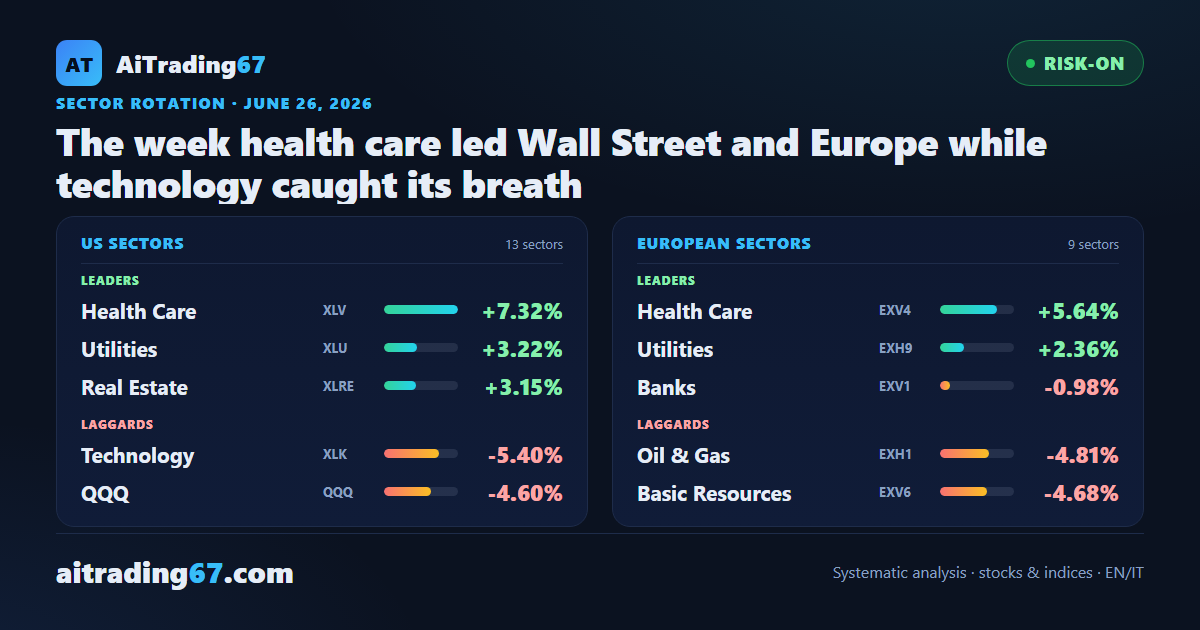
In the United States the snapshot is that of a market changing horses. At the top, and by a wide margin, health care: +7.32% in a single week, RSI at 62.7 and a MACD histogram turning decisively higher. After months on the sidelines, the defensive sector par excellence is once again drawing capital. Right behind it, the other two strongholds of shelter: utilities at +3.22% and real estate at +3.15%, both in a bullish regime and with rising relative strength. Consumer staples kept pace too, with a more modest advance. It's the classic quartet of caution moving together.
The middle of the ranking is flat calm. Industrials closed essentially unchanged (+0.16%), but with an RSI at 69.8 that says plenty about accumulated tension: it's the most stretched sector on the board, near overbought. Financials closed exactly at the flat line, still in a constructive regime but without thrust. Energy scraped a microscopic plus sign (+0.13%) that changes nothing of substance: bearish regime, RSI at 48.6 and an elevated ADX at 33.7 confirming a trend still pointing down.
At the bottom, the real correction. Technology gave up 5.40%, the worst of the week, while remaining technically in a bullish regime with an RSI still high at 64.5: it's a shedding of positions after the excess, not a structural breakdown, but the declining relative strength warns that leadership has stalled. Communications fared worse on structure — RSI collapsed to 36.4 and the regime now bearish — and consumer discretionary (-2.38%) confirms the disaffection for anything that smells of the economic cycle. The message is sharp: those who led the rally are catching their breath, those who protect are advancing.
European sectors
Europe tells the same story, almost word for word. Here too health care tops the board with a convincing +5.64%, an RSI at 57.3 and a MACD histogram that has just turned positive: the sign of a sector back in motion. Hot on its heels, utilities, up 2.36% with a robust ADX at 33.2 indicating a well-directed uptrend and with rising relative strength. The defensive script is identical to the American one.
The heart of the European ranking is dominated by the banks, which remain the most interesting story on the Old Continent despite a week of slight pullback (-0.98%). RSI holds high at 66.4, the ADX at 27.0 signals a still-solid trend and the MACD histogram keeps improving: the correction is physiological, the bullish structure is intact and relative strength is rising. It's a pause, not a reversal. Telecom (-1.44%) and industrials (-2.34%) retreated with composure, the former now in a bearish regime, the latter still bullish but with momentum that has faded to neutral.
At the bottom, the resource ballast. European technology lost 3.89%, mirroring its American cousin's correction, with declining relative strength and a deteriorating MACD histogram though still technically bullish. But the real dead weight is basic resources and energy: basic resources crashed 4.68% and oil & gas 4.81%, both in a bearish regime, with weak RSI and falling relative strength. It's the direct translation, on the boards, of the slump in gold and crude. Rounding out the picture, automobiles, stuck at the bottom with an RSI at 39.4 that captures their chronic weakness.
Cross-region comparison & broad indices
The comparison between the two sides, this week, is almost an exercise in symmetry. Both on Wall Street and in Europe the podium is defensive — health care in front, utilities following — and in both the tail is occupied by commodity-linked cyclicals and by technology in correction. There's none of the usual asymmetry between concentrated American tech leadership and a more diffuse European rotation: this time the two engines turn in the same direction, and it's the direction of caution.
The difference, if anything, is one of character. European strength has a more cyclical, value-oriented backbone: the banks remain the structural pillar of the Continent, with an intact trend and only the weekly dip separating them from the lead. In the United States, by contrast, the shelter is purer — health care and utilities — and the tech correction weighs more, because tech is worth more.
And this is where the sector reading spills onto the broad baskets. The crushing weight of technology on the Nasdaq and the S&P 500 explains why both American indices closed the week lower despite the push from defensives: when the most heavily capitalized sector corrects, it drags the index, and the gains from health care and utilities aren't enough to offset it. In Europe, conversely, the health of the banks acts as a cushion for indices with a strong financial component, while the weakness of energy and basic resources penalizes those most exposed to resources. The reading is a single one: as long as money keeps favoring shelter over risk, the defensive sectors will set the pace, and the broad indices will follow the fate of their heaviest sector.