
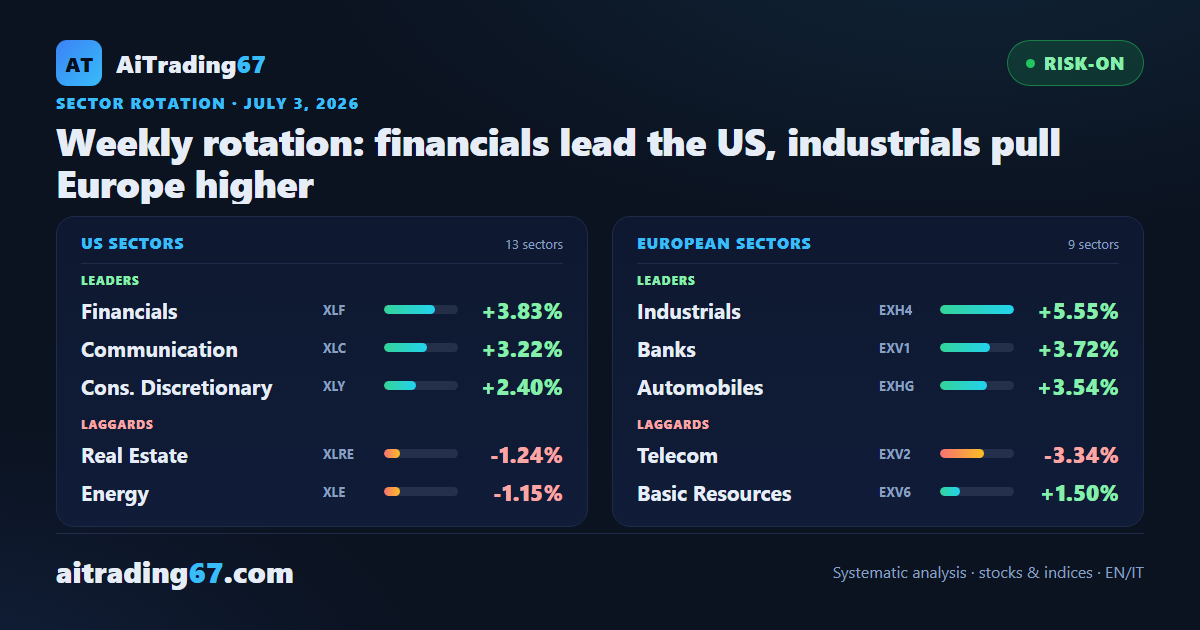
Weekly rotation: financials lead the US, industrials pull Europe higher
Macro context
The backdrop for the week is that of a market that is breathing again. Equity volatility has slipped into a caution zone but is falling fast — down by roughly a quarter over four weeks — and bond-market tension has returned to favorable territory: two signals that speak of fear in retreat rather than euphoria. The gauge measuring the perception of extreme risks also stays relaxed. Participation in the US market, measured by the share of stocks above their moving averages, is only lukewarm, in a caution zone: the advance is there, but not yet unanimous.
On the currency and commodity side the message is sterner. The dollar is essentially flat, in a caution zone, offering no clear direction. Gold has slipped into critical territory, weighed down by a marked decline over the past month; oil is the real casualty, also in critical territory after shedding nearly a quarter of its value in four weeks; and the maritime freight index, a thermometer of global trade, has also retreated into critical territory. The combination — falling volatility, weak commodities, a range-bound dollar — describes a context in which money seeks the cyclical sectors of growth rather than safe havens or resources. That is exactly what the sector rotation confirms up close: leadership broadening out, defensives lagging behind.
US sectors
In the United States the week has a clear center of gravity: finance. The financial sector posts the sharpest gain (+3.83%), with an RSI of 64 signaling strength without yet tipping into excess and, above all, improving relative strength — it is the sector gaining ground on the market, not merely rising with it. Close behind come communications (+3.22%), whose advance is all the more interesting given how fragile the sector's technical setup remains: the medium-term structure is still bearish and price direction only just improving, which makes this rebound more a redemption bet than a consolidated trend. Rounding out the podium are consumer discretionary (+2.40%), a barometer of spending appetite, and health care (+2.12%), the latter solid and well set up with an RSI of 66.
In the middle of the table sit industrials (+1.50%), which despite rising show an overheated RSI of 72 and fading relative strength: the kind of cyclical that has already run a long way. Further back, materials (+0.79%) and consumer staples (+0.33%) advance only slightly.
The story of the week, though, is who is missing from the top: technology. The sector that has led for years closed slightly in the red (-0.29%), with an RSI still elevated at 64 but relative strength weakening and a momentum histogram cooling. It is not a breakdown, it is a pause — but a pause that shifts the spotlight elsewhere. At the bottom sit the three sectors most sensitive to rates and commodities: utilities (-0.95%), energy (-1.15%), and real estate (-1.24%). Energy in particular is the only US sector with an openly bearish medium-term structure, consistent with a falling oil price.
European sectors
In Europe the drive is broader and more muscular than across the ocean. At the top, with an advance that clears the field, are industrials (+5.55%): improving relative strength and a bullish structure make this the most convincing sector of the week on the Old Continent. Behind them, banks (+3.72%) confirm their leadership of the cycle: a robust RSI of 70, rising relative strength and the best trend reading among European sectors — the engine that keeps the Italian market in particular on its feet.
A pleasant surprise is the automobiles sector (+3.54%), which posts a solid gain while remaining fragile in its underlying structure, still bearishly oriented: a rebound to read with caution, not yet a reversal. Health care (+3.07%) keeps pace with solidity, rising relative strength and a constructive technical setup. European oil and gas (+2.73%) also rises, but here the contrast is sharp: relative strength improves and yet the medium-term structure stays bearish, in line with a globally weak crude — more a technical rebound than a change of gear.
In the central band sit utilities (+2.10%), basic resources (+1.50%) and European technology (+1.92%), the last making progress but with a cooling momentum histogram, an echo of the pause seen in the US. The clear and isolated laggard is telecoms (-3.34%), the only European sector in decidedly negative territory, with a bearish structure, falling relative strength and a depressed RSI of 46. It is the sector money has left with the most conviction.
Cross-region comparison & broad indices
Set side by side, the two shores tell the same story in two different grammars. In the United States the rotation is more concentrated: a handful of sectors — finance and communications in front — do most of the work, while technology, which weighs enormously on the large indices, taps the brakes. It is a leadership that changes face but stays narrow. In Europe, by contrast, the push is diffuse: industrials, banks, autos and health care all rise with conviction, in a broad and well-attended cyclical rotation. Only telecoms are left out.
The implications for the main indices follow in cascade. The pause in US technology weighs directly on the Nasdaq and, to a lesser extent, on the broad S&P 500 index, where the sector carries a dominant weight: no surprise that these two broad baskets lag the vibrancy of the cyclicals. In Europe the picture is reversed: the combined strength of banks and industrials offers direct support to the indices most exposed to these sectors — the Italian market above all, historically tilted toward banking, and secondarily the German basket, rich in industrials. The overall operational message is of a healthy market rotating toward the cycle, with Europe showing the broadest participation and the United States waiting to see whether its historical leaders will push again or give way.