
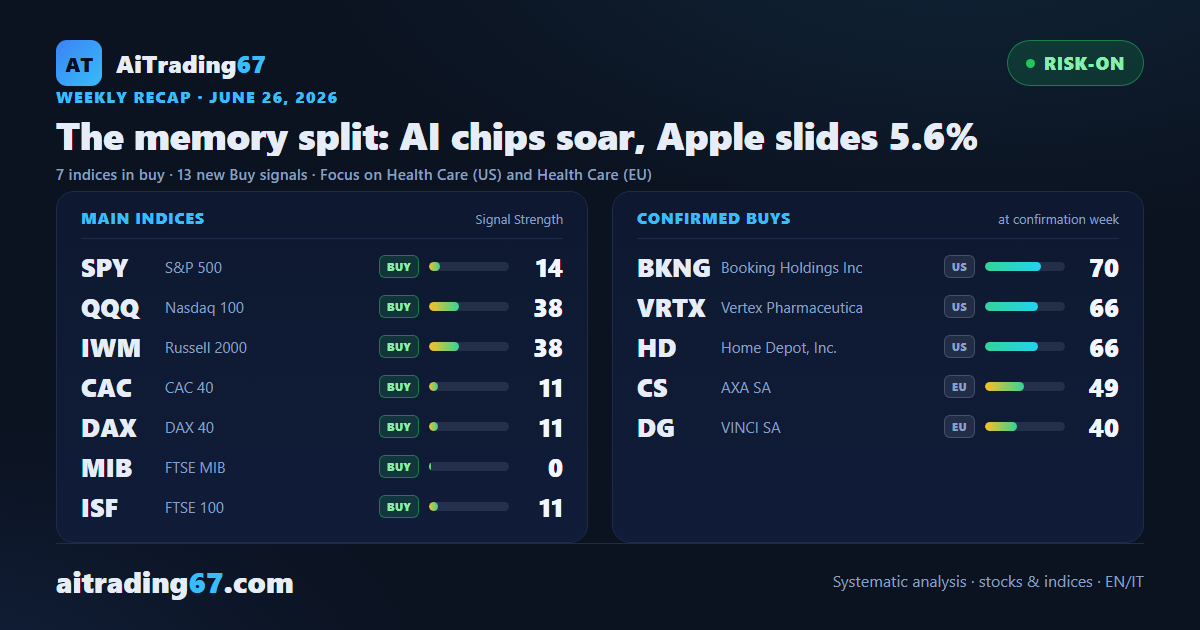
Weekly recap · June 22-26, 2026
The memory split: AI chips soar, Apple slides 5.6%
7 indices in buy · 13 new Buy signals · Focus on Health Care (US) and Health Care (EU)
01
The week in view
The week opens with oil as its compass and ends by proving the compass wrong. After fears that the Strait of Hormuz might close, Monday's market priced the opposite: Iran eased, crude slid and a rotation began that never let up. Tuesday brought a genuine tech scare, with the Korean market's crash as the trigger; Wednesday the fear narrowed onto semiconductors. Then the turn: Thursday's after-bell results from Micron and Qualcomm beat expectations and the big US banks cleared their stress tests. Friday delivered the week's signature — the memory fracture: makers of AI memory chips soared, with SanDisk up over 20%, while the companies that buy those chips paid the bill, Apple sliding 5.6% on announced price hikes. Core inflation ticked up to 3.4%, yet the market digested it by rotating rather than fleeing. Beneath the surface the weekly regime holds and all 7 indices stay in buy mode — but this is rotation, not advance. Money moves into memory, semiconductors and defensives; out of commodities — gold and oil in retreat for weeks — and big consumer tech. A market choosing its horses, to ride with discipline rather than chase.
02
Macro regime
market contextRisk-On
The weekly regime stays favorable, but tension is building underneath: volatility rising over the multi-week arc, the rally's breadth thinning, and commodities in an orderly retreat.
VIX
Neutral
MOVE
Favorable
DXY
Favorable
Breadth
Neutral
03
Main indices
7 Broad ETFsAll 7 indices remain in weekly buy mode, but with conviction that now reads mature rather than fresh, and 5 of 7 show their short-term picture diverging: this is sector fragmentation under a still-intact structure, not a change of direction. The small-cap Russell 2000 is the liveliest — the only one aligned across weekly and daily, and with the best gain in the group; Italy's FTSE MIB is the most tired, its signal momentum all but spent.
State Street SPDR S&P 500 ETF (SPY)Buy · open›
The S&P 500 is in weekly buy mode, but the signal's drive is now contained: it sits closest of the group to its own activation level, with the short-term picture diverging from the weekly. The model reads this as a mature structure — an aged cycle, not an imminent decline. It remains the broadest gauge of the US market: holding direction, but without the energy of the early weeks.
Signal Strength14 / 100
Invesco QQQ Trust Series I (QQQ)Buy · open›
The Nasdaq 100 stays in buy mode and lived the week as the epicenter of the rotation: first the semiconductor scare, then the rebound in memory and AI chips. Signal strength is middling and the cushion above its activation level is thin. This is the index the moment's story runs through — the split between the makers of memory and its buyers.
Signal Strength38 / 100
iShares Russell 2000 ETF (IWM)Buy · open›
The Russell 2000 is the liveliest note in the group: in buy mode, with the best gain among the indices and the only stance aligned across weekly and daily. It holds a wide cushion above its activation level and rides the rotation of these sessions — softer rates and falling oil lift small caps. It remains the signal where risk appetite shows up most clearly.
Signal Strength38 / 100
Multi Units France Sicav (CAC)Buy · open›
The CAC 40 is in weekly buy mode, but the signal's drive is low and the short term has flipped to divergence. The structure holds, yet conviction has cooled: the French market paid for the pause in banks and luxury and for the unwind in European defense. One to watch into the weekly close, to see whether the rotation reinforces or erodes it.
Signal Strength11 / 100
Amundi DAX II UCITS ETF Acc (DAX)Buy · open›
The DAX is in buy mode, but with modest signal drive and a diverging short term. Germany was among the hardest hit by the profit-taking in banks and the unwind in defense — Rheinmetall leading the way. The weekly structure holds and the read is of a mature cycle: it keeps direction, but ranks among the heavier indices in the group.
Signal Strength11 / 100
Amundi FTSE MIB UCITS ETF (MIB)Buy · open›
The FTSE MIB is in weekly buy mode, but it is the most fatigued of the basket: the signal's drive is now spent. Milan stays stretched at its highs, supported by Italian banks, yet the model's conviction has fallen to its lowest. A mature structure par excellence — direction holds, but with no energy left in reserve: one to manage with discipline, not to chase.
Signal Strength0 / 100
iShares Core FTSE 100 UCITS ETF (ISF)Buy · open›
The FTSE 100 is in weekly buy mode and this week brought its short term back into line too, flipping back to buy after a few sessions of divergence: it rejoined the Russell in the coherent camp. Signal drive stays contained, in mature-cycle fashion, but London is the tidiest face of the European rotation — away from the turbulence in tech and continental defense.
Signal Strength11 / 100
04
Sector rotation
US · EuropeIn the US the week rewards defensives: health care runs hard (up over 7%), followed by utilities and real estate, while technology closes at the bottom (down over 5%) alongside energy. Europe mirrors the same logic — health care on top, basic resources, oil & gas and autos at the foot of the table: defensive leadership is identical on both sides of the Atlantic, with technology and commodities its inverted reflection.
US sectors
XLV›
State Street Health Care Selec
rising · +7.32%
XLU›
State Street Utilities Select
rising · +3.22%
XLRE›
State Street Real Estate Selec
rising · +3.15%
XLP›
State Street Consumer Staples
rising · +1.69%
XLI›
State Street Industrial Select
flat · +0.16%
XLE›
State Street Energy Select Sec
flat · +0.13%
XLC›
State Street Communication Ser
falling · -2.99%
QQQ›
Invesco QQQ Trust Series I
falling · -4.60%
XLK›
State Street Technology Select
falling · -5.40%
European sectors
EXV4›
iShares STOXX Europe 600 Healt
rising · +5.64%
EXH9›
iShares STOXX Europe 600 Utili
rising · +2.36%
EXV1›
iShares STOXX Europe 600 Banks
falling · -0.98%
EXV2›
iShares STOXX Europe 600 Telec
falling · -1.44%
EXHG›
EXHG
falling · -1.66%
EXH4›
iShares STOXX Europe 600 Indus
falling · -2.34%
EXV3›
iShares STOXX Europe 600 Techn
falling · -3.89%
EXV6›
iShares STOXX Europe 600 Basic
falling · -4.68%
EXH1›
iShares STOXX Europe 600 Oil &
falling · -4.81%
05
Confirmed Buy signals
at the confirmation weekEight signals from the prior week passed their first test, closing their confirmation week in the green — the first exam that separates a spark from a solid base. In the US the five that held describe the rotation well: Vertex and Ecolab from the defensive and health-care camp, RTX from defense, and Booking and Home Depot from consumer names, back on track after a rough few sessions. In Europe AXA and Vinci remain standing, two value names far from the tech turbulence; from the rest of the world Brazil's Gafisa stands out as the most convincing of the whole group. The European and global lists are thinner than usual — a selective week. They are worth a closer look: a signal that survives its first check rests on firmer ground than a fresh spark — though the decision always stays with the reader.
1
BKNG
Booking Holdings Inc.
Strength 70
›
2
VRTX
Vertex Pharmaceuticals Incorporated
Strength 66
›
3
HD
Home Depot, Inc.
Strength 66
›
4
ECL
Ecolab Inc.
Strength 55
›
5
RTX
RTX Corporation
Strength 55
›
1
CS
AXA SA
Strength 49
›
2
DG
VINCI SA
Strength 40
›
1
GFSA3
Gafisa S.A.
Strength 87
›
06
Ranker rankings
Top by Signal StrengthThe week's fresh US buys share a thread: they emerge into a rotating market, and the model leans toward caution over chasing. At the top sits Evommune, the strongest of the group, but with marked volatility and a price still in the lower half of its range — a case to watch, not to chase. Next comes Expedia, with a solid weekly structure and high conviction, yet here too the model flags an elevated-risk entry. The most balanced profile is Abbott, built on a tidy technical base and riding health care, the week's strongest sector. On the consumer side, Starbucks and Airbnb start out more fragile, with a technical ceiling still to clear and a discretionary group under pressure. Different names, one read: opportunities to study selectively, where the technical work makes the difference. Worth opening the individual pages and forming your own view.
The open US positions are the department of seasoned runners, and the numbers speak for themselves. Fortinet leads the ranking at week 8, up more than 70% with its stop now at breakeven: risk zeroed out, you simply ride it. Oscar Health has more than doubled since entry and has already completed the model's coverage, with much of the position trimmed along the scheduled windows. Same story for Roku and, above all, Advanced Micro Devices, up over 100%, where residual capital now runs on a trailing stop. SanDisk is a case apart: at week 43 of a very long buy, it is the name this week's memory fracture makes strikingly current, even as momentum shows the first signs of slowing. Here the question is no longer whether to enter but how to manage a gain already booked, with discipline. The individual pages tell each trade in detail.
The US sell signals at the top of the ranking trace the week's inverted map. Walmart opens the group at week 4, with flow back in distribution and key support levels as the dividing line. Below it, two names that embody the moment's themes: BP and Occidental Petroleum, energy in full retreat as crude keeps sliding and weekly losses pile up. CME Group is the oldest of the lot, more than three months of decline and a robust gain on the short side, though the daily chart is trying to stabilize. Strategy, meanwhile, is the speculative face of the pressure, with a violent weekly drop. For anyone not already positioned, the model advises against opening new shorts: these declines have been running for a while, and the value here is in spotting where the pressure is fading. Each page lays out the read and the levels.
The week's fresh European buys capture the rotation perfectly: they are almost all defensives and health-care names. Bayer leads, the strongest of the group, emerging on a solid technical base just as European health care runs hottest. Unilever follows, defensive consumer through and through, though conviction is still moderate and argues for measured sizing. Air Liquide starts on an orderly structure but works right at its all-time highs: the model suggests a cautious entry, not a full one. Rounding out the picture are the European health-care ETF, in step with the dominant theme, and reinsurer Munich Re, the weakest of the lot. This is a block far from the tech turbulence, aligned with what the market is rewarding — but first-week signals, to be handled with due caution. The pages help tell the profiles apart.
The open European positions are a mosaic of the continent's strong themes. Infineon leads, up over 60% at week 10: it is the name the AI-semiconductor run keeps in the spotlight right now. Behind it, two Italian banks — Banca Monte dei Paschi and FinecoBank — the face of the credit rally that ran through the month, both with the model's coverage now mature and part of the position already trimmed. There is luxury in Brunello Cucinelli, stalled against a wall of resistance that has capped it for weeks, and miner Anglo American, in profit but with the model's run already complete. The common thread: seasoned, well-set trades where the theme is no longer entry but managing residual capital with a trailing stop. Worth seeing how each one is accompanying its gain.
The European sell signals have one clear protagonist: the automobile. BMW leads the ranking at week 6, up more than 20% on the short side and deeply oversold, while Mercedes-Benz has been driving a decline for a full 22 weeks that keeps delivering. Joining them are the week's newcomers, Volkswagen and the European auto ETF, with the sector down more than 8% over the past month and a bearish structure confirmed at every timeframe. Closing the group is TotalEnergies, a fresh signal that weaves together autos and energy — the continent's two weak fronts. The model advises against opening new shorts on names that have been running for a while: the value here is in reading which declines are accelerating and which show the first signs of holding. The pages go into the detail of each case.
The rest of the world brings two new buys this week, both Brazilian and technically well-made. Qualicorp opens, active in health insurance, with the strongest reading of the group and a base built on a double bottom: solid conviction, but in a setting of marked volatility that demands disciplined management. Itaú Unibanco follows, one of Brazil's major banking names, emerging on an orderly, well-aligned weekly structure in the wake of the financial sector's strength. Two different profiles — one high-conviction and volatile, one steadier and quietly starting — but the same message: fresh opportunities in an often-overlooked market, worth a look precisely for their distance from the moment's themes. The pages lay out how each one is set up.
The rest-of-the-world open positions are all Brazilian and tell a two-speed story. Gafisa leads, the strongest reading of the block, off to a good start with a bullish confirmation week and already in profit: high conviction, but a wide move to manage with discipline. Behind it, the picture grows less certain. BB Seguridade holds an orderly start and a small gain, while Ambev shows a fading signal, its dynamic stop tightening and the next trim window in view. More troubled is Lojas Renner, slightly in the red and carrying an early-exit alert from the model: a case that calls for a decision, not passive waiting. A small, selective block where the difference between names is sharp — and the individual pages help read it.
The rest-of-the-world sell signals are a concentrate of Brazil and commodities, perfectly in tune with the week's macro. Companhia Siderúrgica Nacional leads at week 19, steel in a decline that keeps sharpening and a sizable gain now on the short side. Alongside it, Braskem in petrochemicals and Petrobras in oil, two names that embody the unwind of the commodity trade — even if both show some technical hint of possible stabilization, to be read with caution. Klabin, in paper, has just reabsorbed a bounce, while Oi closed the week higher after months of decline: an early sign of a rebound that, per the model's discipline, suggests closing the short already open. For anyone not positioned, no new entries: here the read is where the pressure holds and where it gives way.
Methodology note — Nothing written here constitutes financial advice, a solicitation to buy or sell financial instruments, or any kind of recommendation. Past performance is not indicative of future results. Trading involves significant risk of loss; the user acts under their own responsibility. Signal Strength is an internal analytical framework used only to rank relative technical quality within the basket. © Fabio Gentili.