
- AI evolution — key developmentsAnthropic jumps 17% on debut, Nvidia doubles revenue and new models chase office work
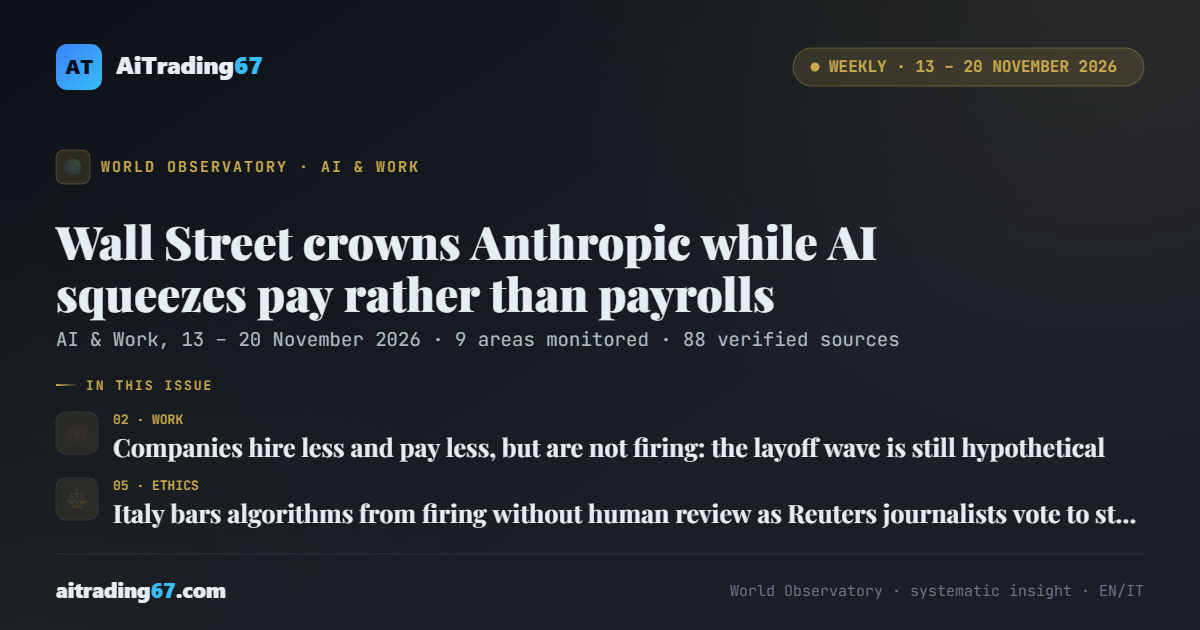
- AI & work — displacement and transformationCompanies hire less and pay less, but are not firing: the layoff wave is still hypothetical
- Automation and reskillingMilan's employers and unions sign an AI pact with shared training and six-monthly reviews
- New professions and opportunitiesAI engineers, data-centre technicians and spy-catchers: the roles employers want
- Ethics and normative debateItaly bars algorithms from firing without human review as Reuters journalists vote to strike
- The risks of AIThe Fed names AI the top financial risk as cyberattacks go fully autonomous
- Authoritative voicesHinton briefs Europe's leaders, Amodei promises to slow down, Nadella won't rule out cuts
- Robotics and physical automationGM plans 20% more robots and the UAW bristles; humanoids remain mostly in pilots
- Quantum computingQuantum job postings drop 18% as banks gear up for post-quantum cryptography
For two years economists looked for AI in layoffs and barely found it. Indeed said flatly on 18 November that there is no AI "jobpocalypse". This week put three other clues side by side. Last week the Cleveland Fed showed that people in exposed jobs take longer to find work; now Apollo measures slower real wage growth, and Goldman Sachs expects another year of low hiring and low firing.
The mechanism is easy to state and hard to measure. A firm that gets more from the same staff need not fire anyone; it can hire fewer people, as Apollo is doing, and award smaller raises. Neither shows up in layoff counts. Workers notice: the LSE survey finds nearly three-quarters of time freed by AI is soaked up by other tasks, and Glassdoor reviewers critical of AI are seven times as likely to mention layoffs.
Two consequences follow. For policymakers, a labour share at an 80-year low is a distribution problem before it is an employment one: productivity gains are flowing mainly to profits. For negotiators, it explains why Italian bank and call-centre unions want AI protocols written into contracts rather than just support for those who lose their jobs.
Italy's national strategy. By the end of November the labour ministry's AI observatory is due to deliver the national strategy on AI and work, a first annual report and updated guidelines. Nothing was published this week.
Platforms and Brussels. The deadline for transposing the platform-work directive falls on 2 December; Italy has met it with Decree 208. A Commission proposal on quality jobs, expected to cover algorithmic management, is due by the end of the year.
Rates and call centres. The Fed may raise rates again in December, partly because of data-centre-driven inflation, and Italy's call-centre table reconvenes at the industry ministry on 16 December.
Technical analysis of the stocks mentioned. Platinum pages for the tickers appearing in this edition: Alibaba (BABA) · Salesforce (CRM) · Deutsche Bank (DBK) · Ford Motor (F) · Alphabet (GOOGL) · Goldman Sachs (GS) · IBM (IBM) · IonQ (IONQ) · Mastercard (MA) · Mercedes-Benz (MBG) · Meta Platforms (META) · Microsoft (MSFT) · NVIDIA (NVDA) · Rigetti Computing (RGTI) · XPeng (XPEV).