
Sector rotation: technology retreats as energy and defensives gather the flows
Macro context
The backdrop stays constructive, but something is stirring beneath the surface. Equity volatility is still at contained levels, yet it is the single biggest riser of the past month: a sign of nervousness building slowly, not of a break. The bond market, by contrast, remains calm, and demand for protection against tail scenarios is modest — no panic in sight, just a slightly raised guard.
On commodities the message comes in two voices. Gold is the soft spot of the picture: a sharp correction has pushed the metal back to the lows of the past 26 weeks. Crude, by contrast, has regained ground over the past month, and it is precisely energy that ties the equity rotation together. The dollar sits still, its momentum easing slightly, while shipping rates improve only marginally.
The overall read is one of defensive rotation inside a still-favorable regime. Money is not leaving the market: it is redistributing. It exits the groups that ran hardest — technology first — and shifts toward energy, real estate and defensives. The United States shows a clean, concentrated rotation; Europe a more diffuse one, with its banks pausing for the first time in weeks.
US sectors
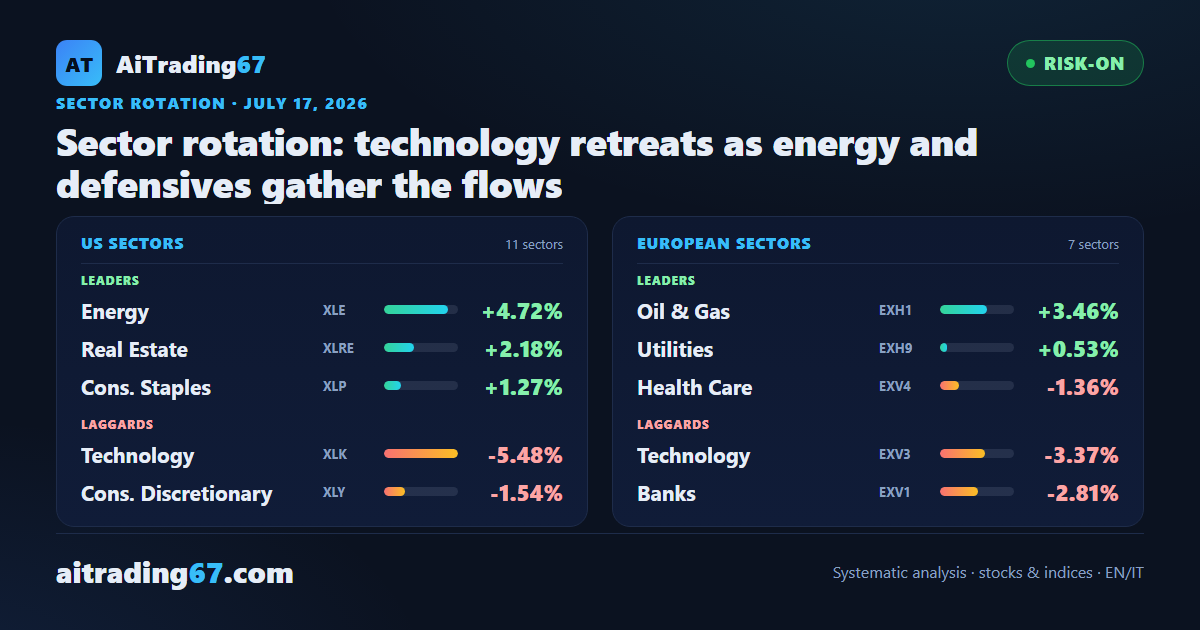
The eye-catching figure is technology at the back of the pack. The technology sector sheds 5.48% over five sessions and is by far the weakest in the market, even though it retains the most directional trend of the entire universe (ADX 31.9) and an RSI still around 57.7. This is the classic pullback of a group that had run too far: structural strength intact, but a week of profit-taking.
Gathering the flows is energy, out in front with a 4.72% gain, supported by the recovery in crude and by rising relative strength. Right behind, the picture turns entirely defensive: real estate adds 2.18% and, alongside financials, is one of only two groups in the firmest band; consumer staples rise 1.27%; financials advance 0.99% with the tautest RSI in the market, at 66.3, marking a banking complex that is still well bid. Health care closes slightly higher, up 0.16%, but with the most constructive momentum of all (MACD at 1.49).
On the weak side, beyond technology, consumer discretionary retreats (-1.54%), industrials slip (-1.38%) and communication services ease (-0.89%), the last already in a medium-term bearish regime along with discretionary, utilities and materials. The snapshot is sharp: the United States is rotating from growth toward value and defense, with energy the only cyclical group being rewarded.
European sectors
In Europe the rotation is softer, but the direction is the same. Leading the way is oil and gas, up 3.46%, in perfect sync with US energy and the recovery in crude: rising relative strength and a well-set trend (ADX 26.3). Further back come automobiles (+1.14%) — still in an underlying bearish regime and with the most depressed RSI in the group, at 43.9 — and utilities, up 0.53% but showing the most directional trend in Europe (ADX 32.3).
The rest of the market is in retreat, and this is where the real story of the week sits: banks, the engine of the entire European year, give up 2.81%. It is a pause, not a reversal — the trend stays strong (ADX 29.7) and the RSI, at 63.5, the highest of any sector on the continent, describes a group that is still bought — but after a long run even the banks stop to catch their breath.
Alongside them, technology retreats (-3.37%, the worst in Europe too, with momentum cooling sharply), basic resources fall (-2.37%, in a bearish regime), industrials slip (-2.01%), telecom eases (-1.99%, also in bearish territory with the lowest RSI after automobiles) and health care declines (-1.36%). The European message is one of diffuse rotation: banks and financial cyclicals step out, energy steps in, while defensives hold up better than the rest.
Cross-region comparison & broad indices
The two sides of the Atlantic tell the same story with different accents. The common thread is strong and unmistakable: energy leads everywhere and technology pays the bill everywhere, crude at the top of the table and growth at the bottom. But the geometry of the rotation differs. The United States shows a concentrated, vertical move — a single cyclical group rewarded, energy, and all the remaining flows pouring into pure defensives such as real estate and consumer staples. Europe, by contrast, rotates more broadly: the pause in its banks, which had driven the whole year, frees up money that scatters across energy, autos and utilities without a clear winner.
The implications for the broad baskets follow accordingly. Technology's heavy pullback explains much of the weakness in the Nasdaq, down 4.16% on the week — far more than the S&P, off 1.54%: when the heaviest-weighted sector retreats, the more tech-tilted index suffers most. In Europe the brake on banks weighs above all on the financially-heavy indices, starting with the Italian market, where the weight of the banking sector is decisive. The operational read is of a market repositioning without changing direction: anyone watching leadership would do well to follow energy and to keep an eye on whether technology is merely catching its breath or beginning something deeper.