
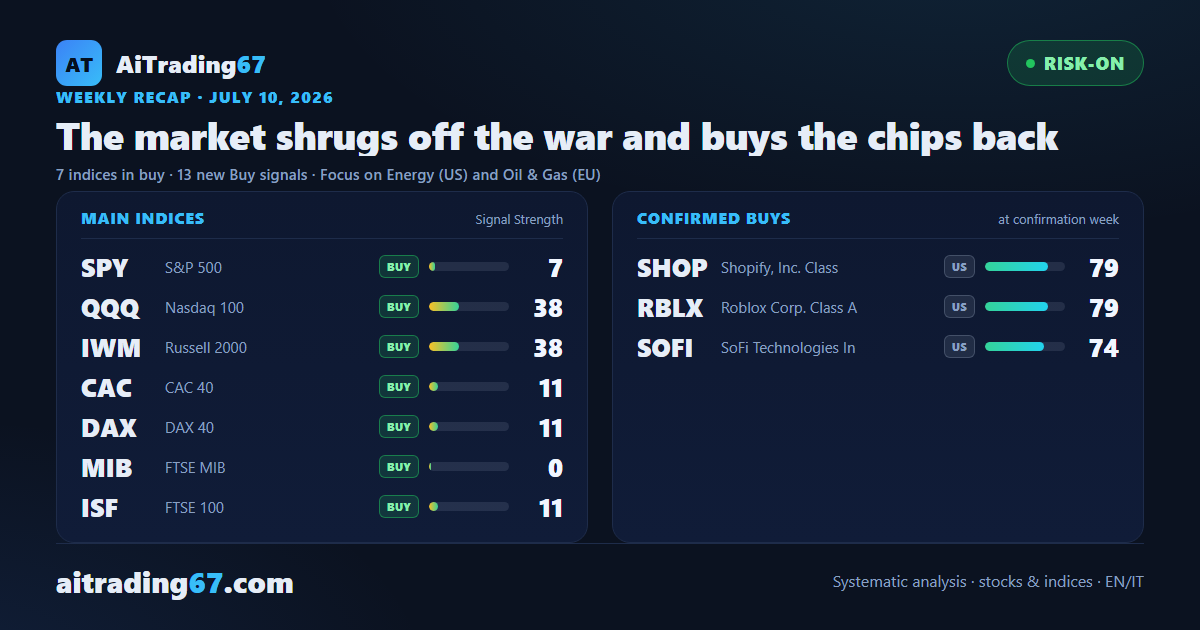
Weekly recap · July 6-10, 2026
The market shrugs off the war and buys the chips back
7 indices in buy · 13 new Buy signals · Focus on Energy (US) and Oil & Gas (EU)
01
The week in view
The macro backdrop stays friendly — equity fear down roughly 15% on the month, market breadth widening for a second week, oil off more than 15% — yet the week lived on shocks. With the full front reopening after the holiday, the fresh crop had broadened from defensives to the most beaten-down growth; then two blows in quick succession flipped the table, a Korean memory miss that cracked the chips and the Strait of Hormuz, all the way to the formal break of the US-Iran ceasefire. For two sessions money rushed into safe harbors. Then, on Friday, the twist: the market waved off the war and bought semiconductors back — SanDisk up more than 10% — while fear fell over 6% in a single day. The week's lesson is written by the defensive rotation that lasted all of forty-eight hours: AstraZeneca shed 6.2% on a failed Phase III trial, a corporate event no setup can foresee. Beneath the surface the regime holds and financials remain the steadiest thread, yet nearly half the new signals already have the short timeframe against them: a market that wants to buy, still waiting on confirmation.
02
Macro regime
market contextRisk-On
The underlying regime stays favorable: fear in retreat, market breadth still widening, and a falling oil price easing the pressure on prices.
VIX
Neutral
MOVE
Favorable
DXY
Neutral
Breadth
Neutral
03
Main indices
7 Broad ETFsThe seven headline indices are all still in buy mode, but at two clear speeds. The US leads: the S&P 500, the Nasdaq 100 and the small-cap Russell 2000 are running double-digit gains since entry, and the Russell remains the year's leader. Continental Europe lags — Paris and Frankfurt in the red on the week, with thin profits — while London is the tail-ender, the only index in loss and far from its highs. Milan is the group's paradox: among the best profits, yet with conviction at the floor and price stretched tight, under the watch of the spread.
State Street SPDR S&P 500 ETF (SPY)Buy · open›
The S&P 500 has been a buyer for thirteen weeks and runs at +11.1% since entry, a whisker from its all-time high. The week added 1.4% and the weekly RSI at 65 confirms a solid stance, with the MACD improving. Signal strength, though, stays the lowest of the US trio, at 7 out of 100: the trend is mature and broad, measured conviction modest. It is the benchmark quietly doing its job, without drama.
Signal Strength7 / 100
Invesco QQQ Trust Series I (QQQ)Buy · open›
The Nasdaq 100 carries the group's fullest conviction, strength 38 out of 100, and the week of the chip rebound added 1.8%, for an 11.8% profit since entry. But below the surface not everything is green: the weekly MACD is worsening and the index stays 3.1% off its highs. It is the liveliest buy for conviction, with an engine — semiconductors — that started turning again on Friday after the week's scare.
Signal Strength38 / 100
iShares Russell 2000 ETF (IWM)Buy · open›
The small-cap Russell 2000 is still the group's best profit, +13.3% since entry, and keeps the year's leadership. Strength at 38 out of 100 puts it level with the Nasdaq for conviction, but the week gave back a touch (-0.5%) and money flow is hinting at distribution while price holds high: a quality downgrade, not a sell signal. That flow is exactly where to keep watching.
Signal Strength38 / 100
Multi Units France Sicav (CAC)Buy · open›
Paris's CAC 40 stays a buyer, but it is among the most fatigued: the week shed 2.1% and the profit since entry has thinned to 3%. Strength at 11 out of 100 and a worsening MACD tell of a signal that holds direction without thrust, weighed down by a hard week for luxury and continental banks. A live but dull buy, to watch for its hold rather than its push.
Signal Strength11 / 100
Amundi DAX II UCITS ETF Acc (DAX)Buy · open›
Frankfurt's DAX is the European index that suffered most on the week, down 2.8%, and the profit since entry is now a slim 1.3%. With strength at 11 out of 100, a falling MACD and price 3.1% below its highs, the buy signal holds by a thread: Germany paid for the chip and industrial slide, the very sectors that ended the week at the bottom in Europe. A buy to handle with care.
Signal Strength11 / 100
Amundi FTSE MIB UCITS ETF (MIB)Buy · open›
The FTSE MIB is the basket's paradox: among the group's highest profits, +13.2% since entry, yet with signal strength at zero, the absolute floor. The weekly RSI at 70 marks an index stretched tight at its highs, the MACD is worsening, and hanging over Milan is the Italy-Germany bond spread, the only stress rising for three weeks. Direction holds, but with no energy in reserve and a red line to watch: the finger stays on the profit-taking trigger.
Signal Strength0 / 100
iShares Core FTSE 100 UCITS ETF (ISF)Buy · open›
London's FTSE 100 is the group's tail-ender: it is the only one of the seven in loss since entry, at -1.5%, and stays the furthest from its highs, nearly 11% below. The week gave back another 1.5%, the MACD sits in negative territory and strength at 11 out of 100 confirms a weak signal. The collapse of AstraZeneca, one of the index's heavyweights, did not help. A buy on paper, but the most fragile of the seven, one to keep under observation.
Signal Strength11 / 100
04
Sector rotation
US · EuropeThe week's sector rotation draws a sharp contrast between the two shores. In the US, energy leads (+3.49%), revived by the oil scare, and technology follows (+2.87%), with communication services close behind (+1.86%): the sector face of Friday's rebound. In Europe the picture flips, with the three laggards all continental — technology (-2.61%), health care (-3.61%) and industrials (-3.66%) — bearing the worst of the week. It is the portrait of risk restarting across the Atlantic while the Old Continent takes the hit.
US sectors
XLE›
State Street Energy Select Sec
rising · +3.49%
XLK›
State Street Technology Select
rising · +2.87%
XLC›
State Street Communication Ser
rising · +1.86%
XLF›
State Street Financial Select
flat · +0.16%
XLY›
State Street Consumer Discreti
flat · +0.10%
XLRE›
State Street Real Estate Selec
falling · -0.51%
XLI›
State Street Industrial Select
falling · -1.08%
XLV›
State Street Health Care Selec
falling · -1.77%
XLB›
State Street Materials Select
falling · -2.15%
European sectors
EXH1›
iShares STOXX Europe 600 Oil &
rising · +0.71%
EXV1›
iShares STOXX Europe 600 Banks
flat · -0.18%
EXH9›
iShares STOXX Europe 600 Utili
falling · -1.89%
EXV6›
iShares STOXX Europe 600 Basic
falling · -2.52%
EXV3›
iShares STOXX Europe 600 Techn
falling · -2.61%
EXV4›
iShares STOXX Europe 600 Healt
falling · -3.61%
EXH4›
iShares STOXX Europe 600 Indus
falling · -3.66%
05
Confirmed Buy signals
at the confirmation weekEight buys that launched last week cleared their confirmation week by closing higher: five in the US, none in Europe or the UK, three in the rest of the world. Confirmation matters, because a trade's second week is the first real test — it separates the signal that holds from the one that fades. The US group is the most telling: these are the very growth names the fresh crop had reignited — Shopify (strength 79), Roblox (79), SoFi (74) and MercadoLibre (70) — walking out of a week of shocks with their heads high, with Charles Schwab (55) rounding them out, clean across horizons but with earnings near. Europe comes up empty this week. From Brazil come three confirmations of a defensive, financial cast — Ultrapar (74), Sabesp (59) and Itaúsa (55). A signal that survives its first test rests on firmer ground: worth reading one by one.
1
SHOP
Shopify, Inc. Class A
Strength 79
›
2
RBLX
Roblox Corp. Class A
Strength 79
›
3
SOFI
SoFi Technologies Inc
Strength 74
›
4
MELI
MercadoLibre, Inc.
Strength 70
›
5
SCHW
Charles Schwab Corp
Strength 55
›
None this week
1UGPA3
Ultrapar Participacoes S.A.
Strength 74
›
2
SBSP3
Companhia de Saneamento Basico do Estado de Sao Paulo SABESP
Strength 59
›
3
ITSA4
Itausa SA Non-Cum Perp Pfd Registered Shs
Strength 55
›
06
Ranker rankings
Top by Signal StrengthThe fresh US opportunities number six, and they tell of a week of signals changing direction. IBM leads (strength 72), the strongest of the group: the old sell signal gives way to a buy, but price is working within a step of its all-time highs and on the last bar sellers took back control — our technical analysis flags trading as not recommended and calls for patience on a pullback. The most striking case is Meta (strength 59), which jumps 14.8% on the week, closes out eight weeks of decline and flips the signal with a spotless weekly structure and the MACD just crossing bullish. Around them, three returns to buy off a daily double bottom: PayPal (strength 65), bouncing with 81% of volume on the buy side; Regeneron (strength 59), on an 8% rebound; and PG&E (strength 54), the most cautious, with earnings on July 23 approaching. Names to study rather than chase: almost all still want confirmation.
The US positions in progress number one hundred and twenty-nine, and the front-runners are a lesson in managing mature trades. Fortinet leads (strength 87), at +82.5% since entry, with the weekly RSI at 84 deep in overbought and the MACD starting to roll over: the trend still burns, but the first signs of fatigue show. Alongside, two triple-digit stories: Oscar Health (strength 87), past 111% in profit, with the stop now trailing the Inversion Point, and Advanced Micro Devices (strength 87), up 7.7% on the chip rebound to +127.7%, even as money flow and momentum have been cooling for a month beneath the surface. Rounding out the top are Roku (strength 86, +37% in week thirteen, rejected at its highs) and Datadog (strength 86, nearly doubled, RSI at 73 and the first cracks showing). The message is uniform: here the job is to protect the profit banked, not to add.
The US sell signals still active number one hundred and thirty-seven, and the top of the strength table separates the decline that accelerates from the one that eases. Quanta Services (strength 66) opens the ranking in week six: capital flow is deepening into distribution, but on the surface the drop is braking — -1.5% versus -2.8% the week before — and the short is already past 5%. Carnival (strength 63) is the week's reversal: from a confirming buy to a fresh sell signal in seven days, on a 3.9% drop. More directional are Ballard Power (strength 57), accelerating lower by 12.5% with sellers at 96% and the short past 27%, and Blaize (strength 57), at fresh lows with distribution thickening again. In between sits PepsiCo (strength 61), down 4.7% but finding a daily double bottom, the short in week seventeen up 8.4%. Cases to monitor, not to open from cold.
The fresh opportunities in Europe and the UK are five, and they carry a financial, domestic stamp. Leading is Fincantieri (strength 74), the week's strongest new buy with a 6.2% jump, even as the last bar sees sellers regain ground and the stock slip into distribution: a case to handle with care in week one. Next come two financial-services names running hot: Nexi (strength 63), up 9% off its own moving average with 86% of volume on the buy side, and London Stock Exchange (strength 59), closing +2.7% with a bullish engulfing bar sealing the turn. Prudential (strength 52) starts on a clean breakout, with nearly 80% of trading on the buy side and no warning flags. Rounding out is E.ON (strength 47), the most cautious: a double bottom revives it, but the week still closed slightly lower. Signals to study at the zone, not to chase.
The European and UK positions in progress number sixty, and the top blends a freshly confirmed buy with now-mature trades. In first place is Bayer (strength 89), at +6.64%: the confirmation week gave back 6.1% and sellers came back to the fore, the same weakness the model had already flagged — discipline calls for a cautious trim. Next is Infineon (strength 89), +48% in week twelve, pulling back 6.3% but with the weekly structure still intact above the Ichimoku cloud. Then luxury and Italian banks: Brunello Cucinelli (strength 83), where sellers are back above 60% of volume; FinecoBank (strength 83), adding 1% but slowing its pace; and Banco BPM (strength 79), the runner that keeps running, at +23.4% with buyers at 87% and the RSI climbing. A block that alternates profits to defend with a fresh buy to handle with the caution the model recommends.
The European and UK sell signals still active number fifty-four, and the top of the strength table is taken by fresh, directional reversals. Leading is Vinci (strength 100), which flips from a weak buy to a new sell signal by shedding 7%, making lower lows at a steady pace. Right behind is Italgas (strength 99), another reversal, with barely 6.7% of volume on the buy side. Prysmian (strength 93) is the most striking case: after twenty-six weeks in a buy that reached +62.77%, the week loses 7.7% and the sell fires, though it stays structurally very high above its long-term average — there is room to fall. More nuanced are ENAV (strength 59), which flips but finds a daily double bottom, and Thales (strength 58), where late June's bounce has already vanished with sellers at 91% and the short at 4.5%. Across all of them our read discourages fresh entries: positions to monitor.
The fresh opportunities in the rest of the world are two, both Brazilian, and they sit on a conviction to read with measure. Leading is Cosan (strength 76), closing +7.7% with a breakout above its seven-day high, backed by a daily double bottom and volume almost entirely on the buy side: a wide move, even if weekly volume is contracting, a detail not to overlook. Next is CPFL Energia (strength 54), rebounding 4.8% off a double bottom with the session almost fully on the buy side, after the old sell signal faded just short of the Inversion Point. The weekly structure is bullish and conviction sits in the middle. Two signals from the new Brazilian perimeter — an energy conglomerate and an electric utility — consistent with the defensive, financial stamp of the moment, but to study with the caution of medium-conviction names.
The positions in progress in the rest of the world are eight, all Brazilian, and the top blends high strength with wide moves. Qualicorp leads (strength 86), which even while shedding 5% doesn't convince on the sell side: daily volume stays 85.7% on the buy side and money flow is positive. Next is Ultrapar (strength 74), in its first week with an 11.6% jump out of a double bottom, though it is already working within a step of its all-time high. Then Sabesp (strength 59), closing its confirmation week at +2.4% with the structure still bullish, and Itaúsa (strength 55), bounced 8% off its own moving average, where the model suggests strengthening despite a couple of warning flags. Rounding out is Ambev (strength 47), in week nine, where the MACD has turned lower and the signal shows signs of fatigue. A young block, to manage name by name.
1
QUAL3
Qualicorp Consultoria e Corretora de Seguros S.A.
Strength 86
›
2
UGPA3
Ultrapar Participacoes S.A.
Strength 74
›
3
SBSP3
Companhia de Saneamento Basico do Estado de Sao Paulo SABESP
Strength 59
›
4
ITSA4
Itausa SA Non-Cum Perp Pfd Registered Shs
Strength 55
›
5
ABEV3
Ambev SA
Strength 47
›
See all 8 →
The rest-of-the-world sell signals still active number twenty-one, and the top of the strength table must be read with care, because it blends crashes and declines running out of road. Gafisa (strength 100) dominates the ranking after a 37% plunge that flipped a buy into a fresh sell signal: buyer dominance collapsing, a sharp distribution phase. Oi (strength 66) shed 17.5%, rejected at its short-term highs, with the short past 50% in week nineteen. Vale (strength 45) loses 5.9%, its sharpest drop of the month, with the RSI at its lows and the ADX falling for four weeks: the trend is losing conviction, the short near 9%. At the opposite end sits Bradespar (strength 35), where a 3.3% drop finds no confirmation in the flows — money flow has turned positive and is rising. Rounding out is MRV (strength 32), where a 7.7% drop with sellers at 70% reignites the continuation, the short past 34%. Mature positions, to monitor rather than open.
Methodology note — Nothing written here constitutes financial advice, a solicitation to buy or sell financial instruments, or any kind of recommendation. Past performance is not indicative of future results. Trading involves significant risk of loss; the user acts under their own responsibility. Signal Strength is an internal analytical framework used only to rank relative technical quality within the basket. © Fabio Gentili.