
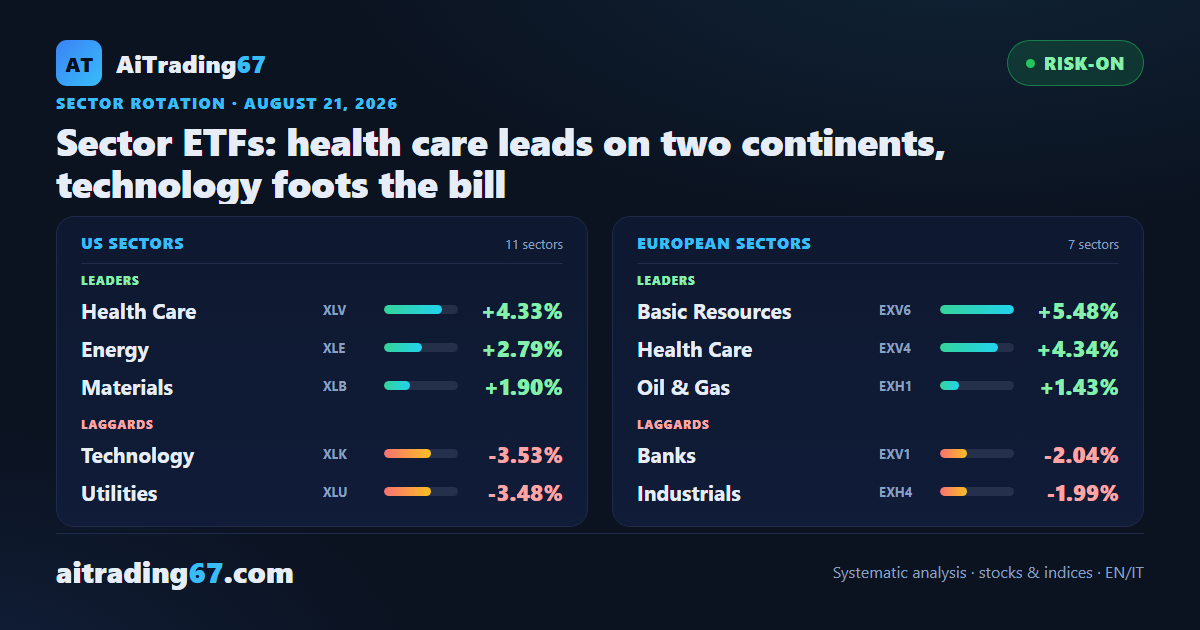
Sector ETFs: health care leads on two continents, technology foots the bill
Macro context
The macro backdrop stays permissive: no operating blocks, no brake on position size. Equity volatility is contained and has come down sharply over the past month, and with it the premium the market pays for tail protection has deflated; fixed income is calmer still.
The real engine sits on currencies and metals. The dollar is weak, parked in the bottom quarter of its half-year range with momentum still pointing lower; gold is outright strong and has just turned its medium-term momentum higher. When the reference currency softens and metals run, money moves towards what is measured in tonnes and barrels.
One reading is the key to the week: US market breadth — the share of stocks genuinely taking part in the move — is still in the caution band, but it has improved markedly. The indices lost ground not because participation drained away, but because the heavyweights were the ones giving up. And the rotation, this time, points the same way on both sides of the Atlantic.
US sectors
Only three of the eleven US sector ETFs closed higher. Health care (XLV) leads at 4.33%: the strongest MACD histogram of the survey and still improving, a bullish regime, rising relative strength, ADX at 25.5. The single caveat is RSI at 73.3, the highest of any sector measured on either side of the ocean. The rope is taut.
Energy (XLE, +2.79%) is technically the cleanest case: ADX at 29.5, the highest on the board, a clearly improving histogram, rising relative strength. Materials (XLB, +1.90%) show the opposite profile — a histogram just back above the zero line, rising relative strength, but ADX at 13.8: the direction is there, the structure is not.
The middle is flat: staples (XLP, -0.12%), discretionary (XLY, -0.15%) and real estate (XLRE, -0.42%) finished near unchanged in a bullish regime, holding rather than leading. Financials (XLF, -1.17%) gave ground in orderly fashion, histogram still positive and RSI at 67.3 describing a sector catching its breath; communications (XLC, -1.37%) stay fragile, with a bearish regime and RSI at 48.8.
Three heavyweights close the board. Industrials (XLI, -3.36%) suffered the sharpest momentum deterioration on the list: histogram negative, relative strength falling. Utilities (XLU, -3.48%) confirm a damaged picture: bearish regime, RSI at 41.1, the lowest US reading. And technology (XLK) finished last at -3.53%, with ADX at 27.1 measuring how directional the move is. Technology stocks did not take a pause: they handed over the baton.
European sectors
The Continent tells the same story with a different accent: four of nine sectors higher, and health care is not the one on top. Basic resources (EXV6) lead with a 5.48% jump, the best result of the whole survey. The technical picture is still being built: the MACD histogram sits below the zero line but recovers more than any other European sector, relative strength is rising and ADX at 24.9 says directionality is already there.
Right behind sits health care (EXV4, +4.34%), an almost identical gain to its US cousin and the most telling coincidence of the week. Momentum, though, has only just turned positive and ADX at 10.7 is the weakest reading in the survey: a young move with no structure. Oil and gas (EXH1, +1.43%) continues in a bullish regime with RSI at 62.5 and a recovering histogram, while automobiles (EXHG, +0.84%) close the winners with the usual caveat — rising relative strength, but a still bearish regime and ADX at 11.4.
At the bottom, four names that say different things. Utilities (EXH9, -0.76%) stay bearish with RSI at 48.1 and momentum still deteriorating; telecoms (EXV2, -1.33%) share the regime and the RSI, at 48.2, but have stopped getting worse. Technology (EXV3, -1.88%) follows its US counterpart, histogram just turned negative and relative strength falling, while industrials (EXH4, -1.99%) lose ground yet keep clearly positive momentum. The name to isolate is banks (EXV1, -2.04%), bottom of the class: ADX at 33.3 is the highest of every sector measured, the regime stays bullish and RSI at 65.7 belongs to a sector that has run for a long time. Not a reversal — a breath.
Cross-region comparison & broad indices
For once the comparison produces agreement rather than contrast. The top two slots are the same in both regions — health care and the resource complex — and both tails share technology. Health care closed at 4.33% in the United States and 4.34% in Europe: two markets, two baskets, the same number. Symmetry like that rarely comes from the fundamentals of a single market: it comes from a shared variable, a weak dollar with strong gold.
Two differences still matter for the broad baskets. In the United States the weakness is concentrated in the heavyweights, and it shows in the gap between the broad basket (-1.37%) and the technology basket (-2.41%), whose relative strength is falling: anyone tracking the US technology index pays for the same rotation twice. In Europe the centre of gravity is banking, and banks are the week's worst performer while remaining the most directional trend: a price problem for the Italian index, not yet a structural one. For anyone doing ETF trading across sectors the read is blunt: leadership has not stopped, it has changed hands, and both sides of the Atlantic changed it together.