
Weekly recap · July 13-17, 2026
Oil takes the wheel, chips foot the bill
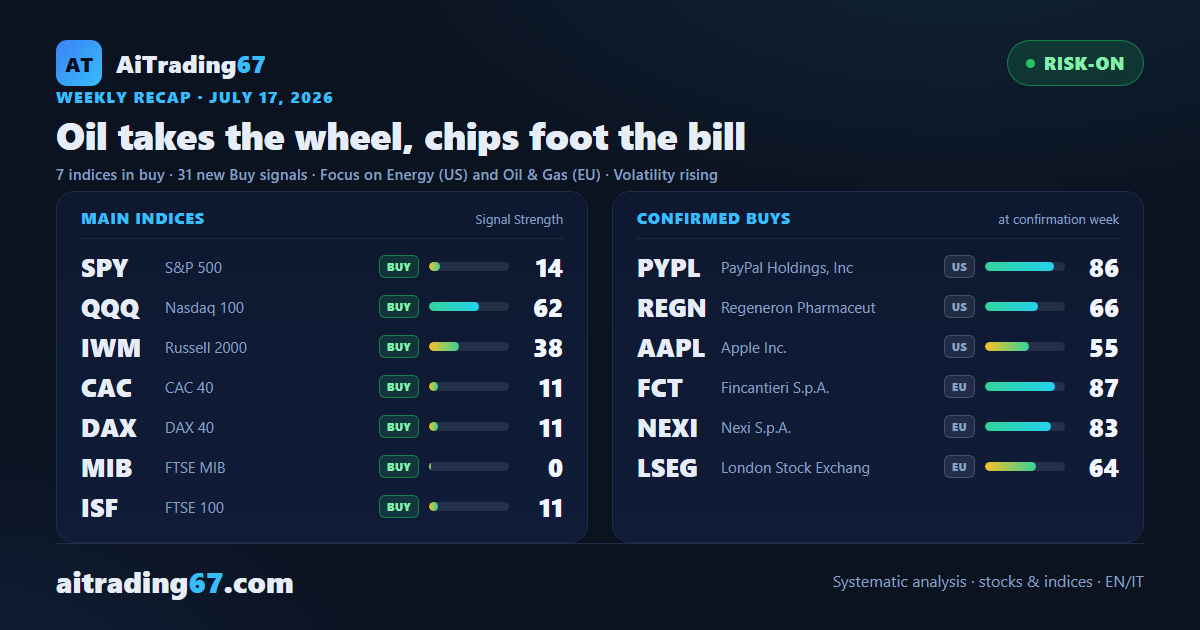
7 indices in buy · 31 new Buy signals · Focus on Energy (US) and Oil & Gas (EU) · Volatility rising
01
The week in view
The week has a winner and a defendant. The winner is energy: the sector tops the weekly board on both sides of the Atlantic, and crude is up 7.8% over the month, becoming the thread that holds the rotation together. The defendant is technology, sold hard everywhere — the US tech sector sheds 5.48%, its European cousin 3.37%, and the Nasdaq is the worst of the indices, down 4.2% across five sessions. In between, one detail carries weight: European banks, the market's engine all year, take a breather and give up 2.81%. Beneath the surface the regime holds — all 7 major indices stay in buy mode — but with a shared note of caution: on every one of them the weekly MACD is deteriorating, a sign the push is cooling broadly. Equity volatility has woken up, climbing more than 14% on the month, while gold stays the soft spot of the picture, down 3.3%. Market breadth, though, is improving: participation widens by 15%. This is a week of reshuffling, not flight: capital stays invested and switches fronts, rewarding defensive quality and energy.
02
Macro regime
market contextRisk-On
A constructive but more watchful regime: volatility has risen and money is turning selective, while staying invested in equities.
VIX
Neutral
MOVE
Favorable
DXY
Neutral
Breadth
Neutral
03
Main indices
7 Broad ETFsAll 7 major indices stay in buy mode, but with a shared signature: the weekly MACD is worsening on each, and momentum is cooling. The Nasdaq pays for the chip drop (down 4.2% on the week), while the small-cap Russell 2000 remains the most profitable of the group (+12.5% since entry). Europe is the softest on conviction — Milan's strength sits at its floor, at 0 — while London is the only one to close higher.
State Street SPDR S&P 500 ETF (SPY)Buy · open›
The S&P 500 stays in buy mode in its 14th week, the trade at +9.4% since entry, but it is the softest on conviction: signal strength sits at 14 out of 100. The week gave up 1.5% and the MACD is worsening, with the index just 2.3% below its highs. Structure holds, but the push is running down.
Signal Strength14 / 100
Invesco QQQ Trust Series I (QQQ)Buy · open›
The Nasdaq 100 is the index footing the week's bill: down 4.2%, dragged by the chip drop, now 7.1% below its highs. It stays in buy mode with the group's highest strength, 62 out of 100, and the trade is +7.2% since entry, but the worsening MACD captures a tech complex split in two — semiconductors down, software more resilient.
Signal Strength62 / 100
iShares Russell 2000 ETF (IWM)Buy · open›
The small-cap Russell 2000 is the most profitable of the basket: +12.5% since entry, with the week nearly flat (-0.7%) and a weekly RSI at 64.5, the liveliest of the group. The rotation toward value, away from mega-cap chips, plays in its favor, and the index stays a whisker from its highs (-2.9%).
Signal Strength38 / 100
Multi Units France Sicav (CAC)Buy · open›
France's CAC 40 is in buy mode in its 14th week, but with strength fading, at 11 out of 100. The week closes essentially flat and the trade stays modest, at +3% since entry, with the MACD worsening. Paris holds its structure, but without drive, and remains 2.7% below its recent highs.
Signal Strength11 / 100
Amundi DAX II UCITS ETF Acc (DAX)Buy · open›
Germany's DAX is the most stretched case: in buy mode in its 13th week, but with the trade now roughly at breakeven (+0.2%) and strength modest, at 11 out of 100. The week shed 1.1% and the MACD is worsening, with the index 4.1% below its highs. The push has run out, and Frankfurt now works close to its activation threshold.
Signal Strength11 / 100
Amundi FTSE MIB UCITS ETF (MIB)Buy · open›
Italy's FTSE MIB is in buy mode and still nicely in profit (+11.5% since entry), but it is the most fatigued of the basket: strength has fallen to 0, the group's floor. The week gave up 1.5% and the MACD is worsening, while a weekly RSI at 66 remains the highest. Milan is stretched at its highs: direction holds, but with no energy left in reserve.
Signal Strength0 / 100
iShares Core FTSE 100 UCITS ETF (ISF)Buy · open›
The UK's FTSE 100 is the only index to close higher, up 0.9% on the week, but it is also the only one just below its entry line (-0.6% since entry, in its 14th week). Strength stays modest at 11 out of 100 and the MACD is in negative territory. London, though, has ample room ahead: it trades 10% below its highs, the widest gap in the group.
Signal Strength11 / 100
04
Sector rotation
US · EuropeIn the US the rotation is clean: energy leads (+4.72%), followed by pure defensives — real estate (+2.18%), consumer staples (+1.27%) and financials (+0.99%) — while technology collapses, down 5.48%, the worst sector on the board. In Europe the pattern repeats with its own accent: energy is still out front, with oil and gas (+3.46%), but the real news is behind it — banks, the year's leaders, shed 2.81% and technology sinks 3.37%. On both shores money is leaving chips and moving into energy and defense.
US sectors
XLE›
State Street Energy Select Sec
rising · +4.72%
XLRE›
State Street Real Estate Selec
rising · +2.18%
XLP›
State Street Consumer Staples
rising · +1.27%
XLF›
State Street Financial Select
rising · +0.99%
XLV›
State Street Health Care Selec
flat · +0.16%
XLU›
State Street Utilities Select
falling · -0.53%
XLI›
State Street Industrial Select
falling · -1.38%
XLY›
State Street Consumer Discreti
falling · -1.54%
XLK›
State Street Technology Select
falling · -5.48%
European sectors
EXH1›
iShares STOXX Europe 600 Oil &
rising · +3.46%
EXH9›
iShares STOXX Europe 600 Utili
rising · +0.53%
EXV4›
iShares STOXX Europe 600 Healt
falling · -1.36%
EXH4›
iShares STOXX Europe 600 Indus
falling · -2.01%
EXV6›
iShares STOXX Europe 600 Basic
falling · -2.37%
EXV1›
iShares STOXX Europe 600 Banks
falling · -2.81%
EXV3›
iShares STOXX Europe 600 Techn
falling · -3.37%
05
Confirmed Buy signals
at the confirmation weekTen buys that launched last week cleared their confirmation week by closing higher — four in the US, five in Europe and the UK, one in Brazil — and that test matters, because a trade's second week is the first real proving ground: it separates the signal that holds from the one that fades. The overall signature is defensive quality and services. In the US, PayPal stands out (strength 86), alongside Regeneron (66), Apple (55) and the utility PG&E (47). On the European side, confirmation reaches Fincantieri (87), Nexi (83), the London Stock Exchange (64), insurer Prudential (49) and utility E.ON (44). From Brazil comes the energy of CPFL Energia (47). The group says one thing: the slow current pushes toward financials, utilities and defensives, and these ten names are already in it. Worth going in to read them one by one.
1
PYPL
PayPal Holdings, Inc.
Strength 86
›
2
REGN
Regeneron Pharmaceuticals, Inc.
Strength 66
›
3
AAPL
Apple Inc.
Strength 55
›
4
PCG
PG&E Corporation
Strength 47
›
1
FCT
Fincantieri S.p.A.
Strength 87
›
2
NEXI
Nexi S.p.A.
Strength 83
›
3
LSEG
London Stock Exchange Group plc
Strength 64
›
4
PRU
Prudential plc
Strength 49
›
5
EOAN
E.ON SE
Strength 44
›
1
CPFE3
CPFL Energia S.A.
Strength 47
›
06
Ranker rankings
Top by Signal StrengthThe fresh US opportunities number twenty, and the top of the table carries the week's signature: energy and reversals. Leading is Occidental Petroleum (strength 72), bouncing 3.7% off its 20-day average with buyers at 73% of the tape, riding the energy sector's surge — though contracting volume argues against chasing. Tied at 72 are two turnaround stories: Adobe, up 6.1% and clearing resistance after a clean double bottom, and Alibaba, adding 2.4% and turning last week's 16.8% jump into a buy. The block's highest strength belongs to Fastly (84): after thirteen weeks on the sell side, four sessions of rising lows reopen the long case. Rounding out is Petrobras (66), completing its breakout above the 18 area with 90% of volume on the buy side. Live but volatile setups: worth a look, with the discipline to wait for confirmation.
The US positions in progress number 112, and the front-runners are a lesson in managing mature profits. Fortinet leads (strength 87), the strongest signal on the board: the trade rises to +87% since entry, but the week leaves a warning, with the weekly RSI at 84.9, deeply overbought, and the MACD starting to roll over. Behind it, two fintech-and-healthcare names deep in profit: PayPal (86), closing its first confirmation week up 22.1% but with a daily RSI already above 80, and Oscar Health (87), past 101% in profit even as the picture cools for a second week. Rounding out the top are Roku (86), regaining ground with 94% of volume on the buy side while still in distribution, and Datadog (86), more than 99% in profit but with a nearly flat week and sellers back in control of the tape. The thread is uniform: here the job is to defend the profit already banked.
The US sell signals in active state number 140, and the top shows the industrial and financial face of the rotation. In first place is American Airlines (strength 100), shedding 11.6% in a week and opening a downtrend of lower lows, with sellers past 90% of volume and earnings now behind it. Alongside, the heavy weakness of biotech: Beam Therapeutics (100) loses 15.8% in a final session of extreme selling, and Ballard Power (100) strings together a second double-digit week (-12.3%), the short past 36% but with an ADX sliding for three weeks, a first sign of fatigue. Then the cyclicals' signature: Citigroup (100) drops 8.1% as buyer dominance collapses, and Caterpillar (100) gives up 7.6% as it starts making lower lows. Across all of them the band flags trading as not recommended: names to watch, not to open from cold.
The fresh opportunities in Europe and the UK number six, and nearly all rise from the ashes of a sell signal. Out front, a pack tied at strength 47, still modest. A2A turns the page after eleven weeks on the sell side: a double bottom in the 2.2 area sparks a rebound with 75% of volume on the buy side, and the stock closes up 1.5%. Same script for Deutsche Boerse, up 3.2% after ten weeks of decline but closing on a bearish engulfing candle that argues for caution. Cleaner is the energy push: Shell gains 6.5% in a breakout week, clearing its 7-day high and bouncing off its 50-day average. Rounding out are Deutsche Telekom (+3.8%, three higher lows) and Tesco (+2.7%, five rising daily lows). The common thread is entries to handle with measure: pictures still in transition, with the ADX slowing and volume contracting.
The European and UK positions in progress number 61, and the top blends fresh confirmations with trades to manage carefully. Leading is Bayer (strength 89): the week closes down 3.3%, but the 3% rebound off its 20-day average with 98% of volume on the buy side tells a sturdier story than the headline — yet the model rates the setup as weak and calls for a cautious trim. Different is Fincantieri (87): the signal that fired last week clears its confirmation with an 8.7% jump and all of the day's volume on the buy side. Then Italian luxury and fintech: Brunello Cucinelli (83) turns the tables with +2.5% but stays in distribution, FinecoBank (83) slows almost to a stop (+0.2%) as sellers retake control, and Nexi (83) closes its confirmation up 3.8% but with only one of four moving averages aligned. A two-speed block: profits to protect and confirmations to read with measure.
The European and UK sell signals in active state number 53, and the top is all technology and industry — the heart of the rotation. In first place is Infineon (strength 100): after twelve weeks of gains that reached 48%, the uptrend breaks and the stock sheds 12.2%, opening a downtrend of lower lows with no sign of exhaustion. Right behind is Prysmian (100), confirming the decline with a 7.2% drop in its second week, and STMicroelectronics (100), down 13.3% in the very week of its July 23 earnings: a sharp reversal from last week's buy. Rounding out are Buzzi (76), falling back 4.7% with sellers at 75% of the tape, and the European technology sector ETF (76), down 3.4% with the last bar ruled by sellers. Across all of them the band flags trading as not recommended: positions to monitor, with no case for fresh entries.
The fresh opportunities in the rest of the world number five, all Brazilian, sketching a medium-conviction profile often born from a double bottom. Leading is Light (strength 76), a utility bouncing 7% off its 20-day average, though in a mixed picture with volume diverging from price. Next is Petrobras (59), adding 3.7% and pressing its 7-day high with 82% of volume on the buy side, riding the energy sector's wave. Then three turns off the lows: Banco Bradesco (54), rising from a clean double bottom even while closing down 3.2%, Gerdau (54), firing with +4.5% and money flow back positive but working right at its highs, and Klabin (50), turning the page after weeks on the sell side with 67% of the tape on the buy side. Defensive- and financial-quality names, consistent with the theme: first week, cautious entries.
The positions in progress in the rest of the world number ten, all Brazilian, and the common thread is double bottoms holding despite red weeks. Leading is Qualicorp (strength 86), the block's strongest signal: it slides another 7% but defends the double bottom in the 1.5 area, from which it had already rebounded 14%, and the first confirmation week stays positive. Next is Cosan (70), closing its confirmation down 5.7% but holding on the double bottom, and Ultrapar (70), the sturdiest case: it closes its second week with another +4.4% and nearly 80% of volume on the buy side, a move the model reads as confirmation. Rounding out are two financials and a water utility: Itausa (66), back to roughly breakeven after its confirmation rebound, and Sabesp (66), which sheds 6.1% but stops at a clean double bottom. A young block, to be managed name by name.
1
QUAL3
Qualicorp Consultoria e Corretora de Seguros S.A.
Strength 86
›
2
CSAN3
Cosan S.A.
Strength 70
›
3
UGPA3
Ultrapar Participacoes S.A.
Strength 70
›
4
ITSA4
Itausa SA Non-Cum Perp Pfd Registered Shs
Strength 66
›
5
SBSP3
Companhia de Saneamento Basico do Estado de Sao Paulo SABESP
Strength 66
›
See all 10 →
The rest-of-the-world sell signals in active state number 16, and the top blends a fresh collapse with by-now mature declines. In first place is Gafisa (strength 100), plunging 34.9% in a single week — three lower highs and buyers completely absent — clearing its confirmation with another drop. Then the long-running shorts: Oi (97), a short under management for 20 weeks and past 55% in profit, loses another 9.1% with the weekly RSI caved to 20.7; Even Construtora (64), in its 20th week and over 33% in profit, gives back 12.9% but sees money flow turn positive, a first fatigue sign; EcoRodovias (61) flips after three weeks of bouncing, down 9.4% with 96% of volume on the sell side; and Bradespar (59), a short of 12 weeks, falls back 2.4% with the ADX at a one-month low. Mature positions: to monitor week by week, not to open now.
Methodology note — Nothing written here constitutes financial advice, a solicitation to buy or sell financial instruments, or any kind of recommendation. Past performance is not indicative of future results. Trading involves significant risk of loss; the user acts under their own responsibility. Signal Strength is an internal analytical framework used only to rank relative technical quality within the basket. © Fabio Gentili.