
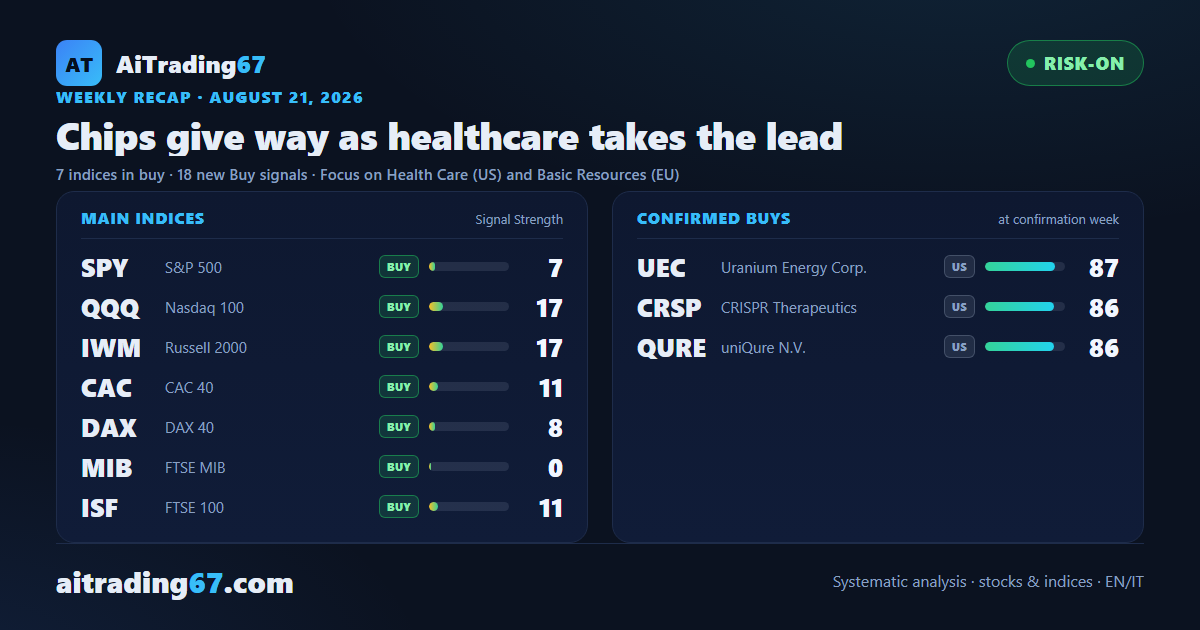
Weekly recap · August 17-21, 2026
Chips give way as healthcare takes the lead
7 indices in buy · 18 new Buy signals · Focus on Health Care (US) and Basic Resources (EU)
01
The week in view
This is the week the money changed address. Healthcare finishes on top on both sides of the Atlantic, above 4% in the United States and in Europe alike, while European basic resources do even better, north of 5%. At the bottom sits technology, down 3.5%, dragging industrials and utilities along with it. Anyone following our daily Observatory saw the centre of gravity shift session by session: it opened on Monday with AI debt and Broadcom, spent three days on European chipmakers and memory, and closed on Friday with Italian banks and energy.
The names tell the same story. Moderna more than doubled in five sessions, up 129.2%, and opens a fresh buy signal; Marvell gains 6.8% and flips a sell signal that was still live seven days ago. On the other side Honeywell sheds 7.7%, Carnival 8.5% and Delta Air Lines 7.8% — all three crossing into sell territory in the same week. Among the earnings names, Walmart drops 10.0% and Baidu 10.1%.
There is a second contrast worth carrying into next week. All seven indices we track remain long, yet six of the seven closed lower and signal strength is scraping the floor. Meanwhile the backdrop keeps improving: equity volatility has fallen by almost a fifth over four weeks and market participation has widened by 13.9%. Capital is switching sectors while staying invested.
The names tell the same story. Moderna more than doubled in five sessions, up 129.2%, and opens a fresh buy signal; Marvell gains 6.8% and flips a sell signal that was still live seven days ago. On the other side Honeywell sheds 7.7%, Carnival 8.5% and Delta Air Lines 7.8% — all three crossing into sell territory in the same week. Among the earnings names, Walmart drops 10.0% and Baidu 10.1%.
There is a second contrast worth carrying into next week. All seven indices we track remain long, yet six of the seven closed lower and signal strength is scraping the floor. Meanwhile the backdrop keeps improving: equity volatility has fallen by almost a fifth over four weeks and market participation has widened by 13.9%. Capital is switching sectors while staying invested.
02
Macro regime
market contextRisk-On
The backdrop stays supportive: stress gauges have been easing for weeks and market participation keeps broadening.
VIX
Neutral
MOVE
Favorable
DXY
Neutral
Breadth
Neutral
03
Main indices
7 Broad ETFsAll seven indices we track remain long, yet signal strength is close to the bottom of the scale and six of the seven finished the week lower. The Nasdaq is the only one carrying a fresh signal, barely open and already below its entry reference; the FTSE 100 is the only one to close higher. The trades running for nineteen weeks on the S&P 500, the Russell 2000 and the FTSE MIB are all comfortably in profit: this is a pause inside mature positions.
State Street SPDR S&P 500 ETF (SPY)Buy · open›
The S&P 500 stays long in its nineteenth week, with the trade up 12.7% from entry. The week closes 1.4% lower and price slips to 1.8% below the record it touched again in mid-August. A weekly RSI of 63.1 is nowhere near excess, but the MACD is deteriorating and signal strength now sits at the bottom of the scale. It is the portrait of a mature position: the structure holds, the energy that carried it here does not.
Signal Strength7 / 100
Invesco QQQ Trust Series I (QQQ)Buy · new›
The Nasdaq is the only one of the seven carrying a brand-new signal, one week old, and it starts uphill: the week ends at -2.4% and the trade already sits 2.4% below its entry reference. Price is 4.7% off the highs, the widest gap in the group after the FTSE 100, and the MACD is working in negative territory. With technology last among sectors, this entry is born against the prevailing wind: worth watching whether next week confirms it.
Signal Strength17 / 100
iShares Russell 2000 ETF (IWM)Buy · open›
The Russell 2000 carries the biggest gain in the group, up 14.8% over nineteen weeks, and stays within a whisker of its record, 1.7% below. The week gives back 1.7% and the weekly RSI, at 64.0, is the second most loaded of the seven. The signal is losing polish, though: the MACD has just crossed lower, the first of the seven to do so decisively. Small caps led the summer leg; this is the week they catch their breath first.
Signal Strength17 / 100
Multi Units France Sicav (CAC)Buy · open›
The CAC 40 sits closest to its own reactivation level: just 0.43% separates it from the reference, the tightest margin of the seven. The week gives up 1.7% and price drifts to 3.0% off its record. The trade, nineteen weeks old, is still up 4.9% — half of what the US indices have banked over the same stretch. Paris is paying for its luxury and technology weighting, precisely the sectors that gave up the most ground this week.
Signal Strength11 / 100
Amundi DAX II UCITS ETF Acc (DAX)Buy · open›
The DAX closes with the smallest decline in the European group, down 1.2%, and stays 1.6% below its own high — the second closest to a record among the seven. The trade, in its eighteenth week, carries a 5.5% gain. Signal strength, however, has dropped to 8 out of 100, the second lowest of the seven, and the MACD keeps deteriorating. Frankfurt is holding its structure better than its European peers, even as the fuel that lit it has burned off.
Signal Strength8 / 100
Amundi FTSE MIB UCITS ETF (MIB)Buy · open›
The FTSE MIB carries the second-largest gain in the group, up 13.5% over nineteen weeks, with the highest weekly RSI of the seven at 65.0. Yet signal strength has fallen to zero out of a hundred — the only one of the seven to hit the absolute floor of the scale. The week sheds 1.7% and price drifts 2.5% away from its record. Italian banks closed the week at centre stage in our daily Observatory: that is where Milan's staying power will be decided.
Signal Strength0 / 100
iShares Core FTSE 100 UCITS ETF (ISF)Buy · open›
The FTSE 100 is the only one of the seven to close the week higher, up 0.8%, and the only one with an improving MACD. The flip side is the distance from its record, 7.7%, by far the widest in the group: London is the laggard of the year. The trade, nineteen weeks old, is up 2.0%, the smallest of the set. With European basic resources topping the week, the index most exposed to that sector finally has something working for it.
Signal Strength11 / 100
04
Sector rotation
US · EuropeIn the United States healthcare and energy lead, both above 2.5%, while technology finishes last at -3.5% with utilities and industrials just above it. Europe says much the same thing with a different accent: basic resources take first place above 5%, with healthcare right behind, in line with the US reading. For once both sides of the Atlantic are pulling the same way, which makes the rotation more convincing than an isolated bounce. The full comparto-by-comparto picture sits in the weekly sector report published the same day.
US sectors
XLV›
State Street Health Care Selec
rising · +4.33%
XLE›
State Street Energy Select Sec
rising · +2.79%
XLB›
State Street Materials Select
rising · +1.90%
XLP›
State Street Consumer Staples
flat · -0.12%
XLY›
State Street Consumer Discreti
flat · -0.15%
XLRE›
State Street Real Estate Selec
falling · -0.42%
XLI›
State Street Industrial Select
falling · -3.36%
XLU›
State Street Utilities Select
falling · -3.48%
XLK›
State Street Technology Select
falling · -3.53%
European sectors
EXV6›
iShares STOXX Europe 600 Basic
rising · +5.48%
EXV4›
iShares STOXX Europe 600 Healt
rising · +4.34%
EXH1›
iShares STOXX Europe 600 Oil &
rising · +1.43%
EXH9›
iShares STOXX Europe 600 Utili
falling · -0.76%
EXV3›
iShares STOXX Europe 600 Techn
falling · -1.88%
EXH4›
iShares STOXX Europe 600 Indus
falling · -1.99%
EXV1›
iShares STOXX Europe 600 Banks
falling · -2.04%
05
Confirmed Buy signals
at the confirmation weekThe five buys that cleared their confirmation week are all American, and the family resemblance is hard to miss: Uranium Energy and Energy Fuels in uranium, CRISPR Therapeutics and uniQure in biotech, MP Materials in rare earths. Three speculative themes, not one defensive name, and signal strength between 86 and 87 out of 100 — the top of the scale. Europe and the rest of the world contributed none: this week, confirmation spoke only American. Why it matters: a signal that survives its first weekly test has already passed the point where most false starts die out, and our method treats it as sturdier than one just born. This is no invitation to buy — these remain volatile names with the risk that comes with them — but the five cards are worth reading before the theme cools.
1
UEC
Uranium Energy Corp.
Strength 87
›
2
CRSP
CRISPR Therapeutics AG
Strength 86
›
3
QURE
uniQure N.V.
Strength 86
›
4
MP
MP Materials Corp Class A
Strength 86
›
5
UUUU
Energy Fuels Inc.
Strength 86
›
None this week
None this week
06
Ranker rankings
Top by Signal StrengthFourteen US stocks turned long this week, and the one at the top of the list is also the story of the month: Moderna more than doubled, up 129.2%, with one of the strongest technical setups in the group — which is exactly why our model flags the opening as high risk, with price now stretched. Marvell gains 6.8% and flips a sell signal that was still alive seven days ago, climbing back above its 50-week average, though buyers are retreating into the latest sessions and earnings are due. Figure Technology jumps 24.4% with buyers taking nearly 80% of the tape, yet close to overbought. Tesla adds 6% with 81% of volume on the buy side and a run of higher lows. Novavax bounces off its 20-day average and closes up 11.1%, carried by healthcare. Five different stories, each worth reading card by card before any stock trading decision.
One hundred and sixty-seven US stocks are running an open buy, and the top of the table is a story of mature trades catching their breath. PayPal leads with a 33% gain since entry: the week closes almost flat, RSI eases from 77 to 68.8, yet ADX is climbing — the trend gaining conviction just as the pace cools. Oscar Health is the standout, more than 120% over nineteen weeks, giving back 2.2% this week after the prior 17.4% jump. Snowflake rebounds 1.2% with buyers taking 92% of the tape and money flow accelerating. CRISPR Therapeutics adds 11.1%, a fourth straight weekly gain. Against the grain sits Fortinet, down 4.1% with money flow flipping negative after sixteen weeks on the positive side, though the trade remains deep in profit. These are positions to follow rather than open: each card sets out where the trade stands.
Ninety-three US stocks sit under a sell signal, and several heavyweight ones were born this week. Honeywell drops 7.7% and flips a buy that had held for three weeks, landing straight at the top of the category: the decline is orderly, lower lows, with buyers almost absent in the latest session. Carnival sheds 8.5% and crosses into sell as money flow turns after twelve positive weeks. Delta Air Lines gives up 7.8% and enters distribution, its MACD dropping below the signal line after fifteen weeks above. Among the more seasoned declines, Baidu loses another 10.1% — its sharpest week since the signal opened — with the short more than 19% in the money in week eleven, while Blaize slows to -19.3% after the previous week's 46.1% collapse. Anyone studying the short side will find the freshest material here.
Only three European and UK stocks turned long this week, and that is telling: the continent took little part in the rotation, and all three come from the sectors that pulled. Glencore leads with an 8.7% jump: last week it was still boxed in a tight corridor under a sell signal seven weeks old, this week it broke out and flipped the picture. The stock trades more than 22% above its 50-week average, though contracting volume says the breakout still needs proving. International Petroleum gains 8.1% with buyers back in charge, even if the weekly structure stays neutral and the stock already works close to its own highs. Sanofi accelerates 4.5% with buyers taking 93% of volume, leaving fifteen weeks of sell signal behind while still sitting below its 50-week average. Basic resources, energy and pharma: this week's photograph in three names.
Seventy European and UK stocks are running an open buy, and the top of the list shows solid positions that moved little. Bayer closes up 0.5% with price above its 50-week average and above the Ichimoku cloud: week eight of the trade, up 2.21%. SAP is the liveliest, up 4.4%, pushing right to its seven-day high with buyers taking 94% of volume and RSI now above 70. Brunello Cucinelli ends slightly lower, down 0.6%, but changes gear on volume: after last week's double rejection at the highs, buyers reclaim 85% of the flow and money flow turns up. Capgemini climbs 2.6% with a bullish engulfing bar on the daily chart, despite European technology losing ground. Rheinmetall is the negative exception, down 3.9% with money flow turning negative. Five stocks to watch to understand where Europe is holding.
Forty-six European and UK stocks sit under a sell signal, and the leading group is dominated by two themes: luxury and semiconductors. Moncler gives up another 3.8%, a second straight red week, with sellers taking 79% of volume and money flow negative for eleven weeks. Infineon drops 9.3% and the decline finally shows in the tape, buyers in clear retreat: the short is in week six and running 12% in the money. STMicroelectronics sinks 7.7% with sellers controlling 92% of daily volume, and the signal, also six weeks old, is already close to 20% in profit. Infrastrutture Wireless Italiane accelerates lower, down 3.9% with sellers at 100% of volume and RSI at 31.7, on the edge of oversold. DX2G, the CAC 40 ETF, rounds it off with a fresh signal at -3.8%. European chips were the through-line of three Observatory pieces out of five.
The rest of the world brings a single fresh buy, and it is worth a look precisely because it stands alone. Oi, the Brazilian telecoms group, remains deeply oversold on the weekly chart with RSI at 24.4, while the sell signal that had accompanied it for seven months steps aside: that decline had banked more than 62% on the short side. A buy signal now fires with strength at 84 out of 100, the highest in the whole category. Two caveats belong here: the ADX slows for the first time after nine straight weeks of climbing, and the level that triggers full entry still sits above price. This is a reversal after a very long decline, the kind of setup where patience matters more than speed, and where a single week rarely settles the question. It also sits apart from the week's other themes: while healthcare and basic resources pulled developed markets, this is an emerging-market telecoms name turning on its own clock. The card sets out exactly where that entry level sits and what still has to happen for it to trigger.
Five Rest of the World stocks are running an open buy, and every one of them is Brazilian. PDG Realty leads with a week up 8.7%, clearing its seven-day high: on the daily chart price bounces 17% off the 20-day average and volume flips to buyers after thirteen weeks of seller control. Light stalls, down 0.9%, with the utilities sector under pressure. Ultrapar gains 7.2% and returns within reach of its all-time high with RSI at 70.2: little room remains before the next resistance. Petrobras climbs 5.4% and its ADX turns higher after fifteen weeks of decline, supported by an energy sector in good form. Klabin rebounds 5.4% off its 20-day average and recovers the breakeven stop that had been breached the week before. Brazil is the one place where energy and real estate ran together this week.
Twenty-five Rest of the World stocks sit under a sell signal, and this week's newcomer arrives with weight. Gerdau collapses 10.1% and flips a buy that was in its fourth week seven days ago: it enters straight at the top of the category with signal strength maxed out at 100 out of 100 and buyer dominance broken in the final bar. Below it the picture is murkier. Sabesp brakes hard after last week's 11.5% plunge: it closes almost flat, down 0.2%, with no new lows and money flow back in positive territory. Itausa stalls too, up 0.1%, though beneath the surface money flow stays in distribution. Braskem recovers 2.8% after the prior 17% crash, with the short more than 42% in the money. Lojas Renner slows its decline to 2% and buyers reclaim 65% of the tape after five weeks. Four of these five declines are losing speed: worth reading the cards before taking them for granted.
Methodology note — Nothing written here constitutes financial advice, a solicitation to buy or sell financial instruments, or any kind of recommendation. Past performance is not indicative of future results. Trading involves significant risk of loss; the user acts under their own responsibility. Signal Strength is an internal analytical framework used only to rank relative technical quality within the basket. © Fabio Gentili.